Features of keeping a lizard at home

What kind of pets do people have for themselves? Most often it is cats, doggies, parrots, hamsters, Guinea pigs. But there are lovers of exotic animals: spiders, scorpions, cockroaches, bats and reptiles. One of the types reptiles are lizards.
Lizard maintenance 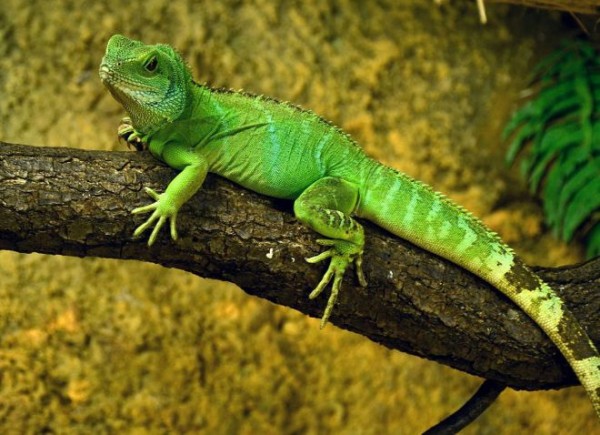

Lizards are different, from small nimble and desert lizards - geckos and zublefars, to large individuals - monitor lizards, iguanas, chameleons. Field lizards very rarely get along in captivity, they can live for a long time, provided a varied diet.
In principle, keeping small reptiles is not particularly difficult. It is imperative for small individuals to purchase a special terrarium, otherwise in the wild they can run away, get sick, injured, hide so that they cannot find it. Larger individuals can do without a terrarium, but it is better to buy one after all, because the animal can get sick in a draft.
It is possible to keep several individuals in one terrarium, but under certain conditions. These should be lizards of about the same age, heterosexual individuals are able to live peacefully only during the period of mating and reproduction, at other times they will simply fight.
Lizards can be propagated when the female reaches the age of two, and the male can reproduce as early as one year. It is believed that early mating can kill the female. After mating, the female should be removed to another terrarium with peat and moss so that the lizard can immediately bury its eggs. After 10 weeks at a certain temperature and humidity, offspring will be born, which also needs to be transplanted to another place. Cubs are fed with vitamin supplements and calcium.
Lizard Terrarium 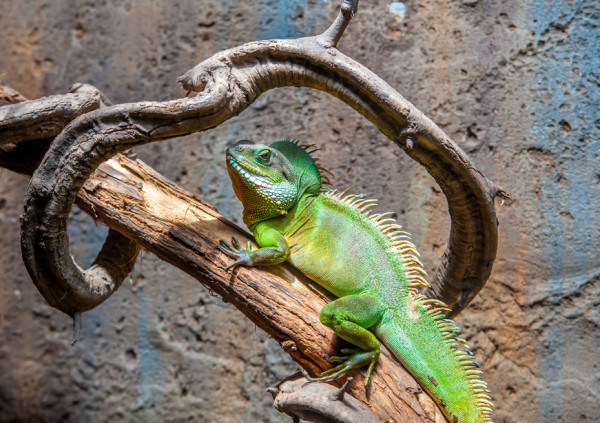

A terrarium for a future pet needs to be selected wisely. It should be as tall as two or three of your pet's lengths. On the bottom, you can put soil without additives and fertilizers, sand, wood shavings for rodents, pieces of paper, pieces of tree bark, or special rugs that can be found at the pet store.
You can stick a few tree branches to the walls so that the lizard can climb on them, just like in its natural habitat. You can also arrange pebbles, climbing structures, artificial plants without thorns in the terrarium. Plants can be written separately - they must be strong, withstanding the weight of the reptile, must be rough so that the lizard does not slip and fall off them, and the plants must be of high quality to withstand high temperatures.
The temperature in the habitat should be of two magnitudes: in one part of the house about 36 degrees, and in the other about 29-30 degrees. At night, it should be at least 21 degrees. Most often, owners purchase a glass-ceramic lamp or an incandescent lamp with the terrarium to heat the hot zone. The soil can be maintained in a certain mode with the help of special rugs.
The lighting should be constantly bright, while the lamp is only ultraviolet. Optimum humidity for reptiles- this is not less than 50-70%. Therefore, in the terrarium in the thirty-degree zone, there should always be a large cup of water so that the lizard can climb into it at any time. You can spray the terrarium with a spray bottle several times a day, but you need to monitor the ventilation so that the fungus does not develop.
What to feed the lizard 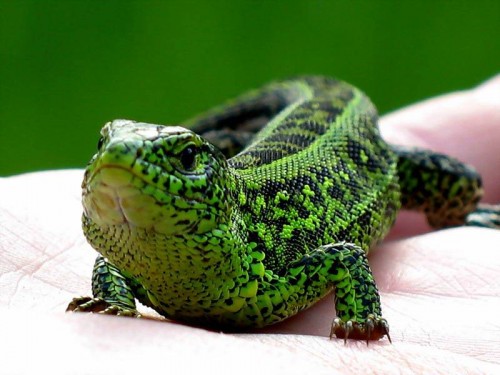

Small cubs need to be fed with tweezers, adults can feed on their own from the cup. Feeding takes place twice a day in the winter season and three times in the summer. The diet depends on which species your reptile is.
Iguanas eat only plant foods: fruits, vegetables. Monitor lizards prefer fish, frogs, snakes, bird eggs. Small nimble lizards can feed on spiders, worms, cockroaches, flies, mollusks. You can combine pieces of meat, for example, with shabby carrots. Do not forget to add vitamins and calcium to your food.