How to remove shellac at home

Shellac, a type of gel polish, occupies almost the main place among the services offered by nail industry professionals. It has almost all the qualities that are so necessary and valuable for modern women: convenience - you can do anything with your hands; reliability - a good master will firmly seal the coating on your nails; durability - you can not think about manicure for up to 3 weeks and time saving - your hands will look well-groomed at any time of the day without any effort. But sometimes it’s very difficult to find time to remove such a manicure in a salon, especially if the coating breaks off unexpectedly.
Contents
How to remove the sticky layer of shellac
The final top coat of sealer is needed to hold together all the previous layers of varnish. This is a kind of “glue”, thanks to which the manicure lasts for such a long time. You've probably noticed that at the end of his work, the master always wipes each nail with a special liquid - a clinser. But if you bought a lamp for gel polish and all the necessary materials, intending to do a manicure with shellac yourself, then you can save a lot on the clinser by replacing it with simple products that are sure to be found in every home.

Of course, such hand-made products are not suitable for you if you plan to plunge headlong into the nail industry and become a true master of your craft. Professionals usually use gel polish and all the necessary materials from the same brand, not only to maintain the style and status of the salon, but also for a better final result. In addition, nail studios try not to skimp on materials, following the rule “the stingy pays twice.” This is why professionals most often use Shellac is the most famous and high-quality line of nail care materials from the American company CND.

A nail technician also needs a cleanser to degrease natural nails before applying any coating on them, be it gel polish, shellac or the most ordinary nail polish, so that it lasts longer. By the way, this is why before doing a manicure, experts recommend washing your hands with soap (we are not talking about simple hygiene) - soap degreases the skin of your hands and nail surfaces well.
At home, instead of a cleanser, you can successfully use ordinary nail polish remover, just be sure to make sure that it does not contain acetone, otherwise it will either dissolve the gel polish or spoil its color, although it is quite suitable for simply degreasing the native nail, without coating.
Shellac remover
The biggest advantage of shellac is its long-lasting properties. This is why almost every second girl does such a manicure, because after spending an hour and a half on this procedure, you may not even remember about your hands for 2-3 weeks, or even longer, until the overgrown nail hole begins to treacherously peek out from below. Unless, of course, you decide to use this method:

But when the time comes to remove the coating, the question arises of how to do this without harm to your nails. No matter how good shellac is, natural nails do not see light under it and practically do not breathe for almost a month. Therefore, after removal, they will somehow look pale, fragile and weak, become thinner and begin to flake off. And if you come across a “professional” who, out of the kindness of his heart, polished the entire upper plate of the nail - and this happens - then it’s a waste of time.
Remove shellac without liquid
You won’t be able to remove shellac or gel polish from any other brand without any liquid at all—it’s not for nothing that it’s so durable. But at home, you don’t have to buy gel polish remover; you can use ordinary nail polish remover with acetone in the composition - the result will be almost the same as in the salon.

Is it possible to remove shellac with acetone?
Many girls believe that acetone corrodes and spoils nails - this is partly true, but few people know that in fact this is just a marketing ploy by manufacturers of materials for the nail industry, because nail polish remover without acetone, which has “unique” properties, is supposedly capable of caring for nails, although in fact it is not much better than acetone-containing liquid. The only difference is that acetone actually dries out the nail plate, so the nail looks lifeless for a while. But you achieved exactly the same effect before you applied gel polish to your nails, using alcohol or a cleanser for this.
Therefore, in the absence of a professional, more or less soft liquid, feel free to take acetone or nail polish remover with acetone.
A quick and easy way to remove shellac
So, if you don’t have time to go to the salon to remove such a manicure, or you decide not to spend your money on this simple procedure, then removing it at home, as you can see, is not at all difficult.
In addition to gel polish remover (as well as simple nail polish remover or acetone, depending on where you end up), you will need:
- ordinary household foil (chocolate foil will also work);
- cotton wool or cotton pads;
- an orange stick for pushing back cuticles or any other similar device;
- scissors;
- rough file for artificial nails.
By the way, in specialized stores for manicure and pedicure they sell ready-made, cut foil with pieces of cotton wool glued on. If you plan to constantly remove gel polish from your nails yourself at home, then you can use this option - at a relatively inexpensive cost, it will significantly save your time.

In addition to the above tools, to remove any gel polish or shellac at home, you need to prepare ten small pieces of cotton wool and cut short strips of foil, about 3-5 cm wide. After that, you can start the fun part.
- Use a plastic nail file to file off the top coat of each finger, making sure not to touch the natural nail.
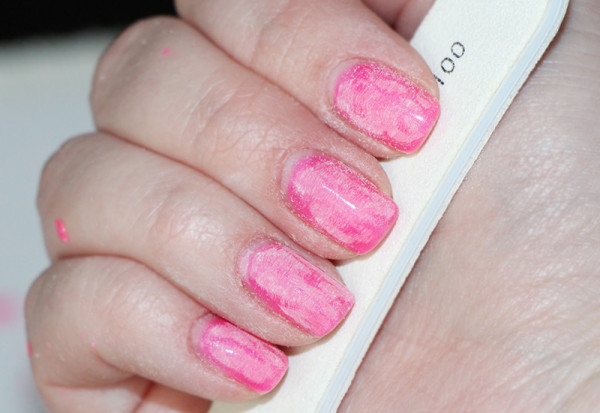
- Generously wet a piece of cotton pad with gel polish remover and press it onto the entire surface of the nail plate.
- Wrap your nail tightly in foil.
- Do this with all fingers.
- Wait 15-20 minutes, without opening the foil during this time. You will feel that your fingertips are in a kind of “steam bath”.
- Unfold the foil on the first finger and carefully remove the remaining swollen shellac with a stick, lifting it up.
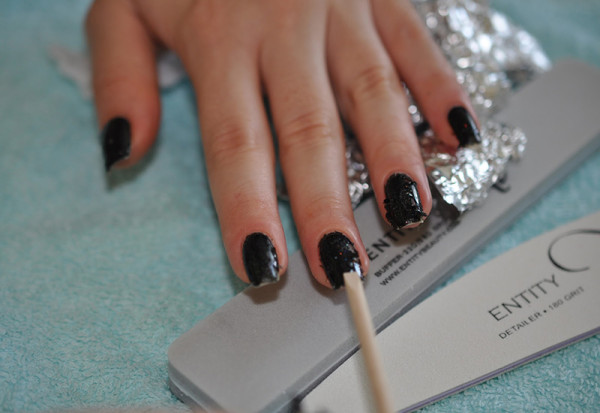
- Do this with each nail, removing the foil “pocket” from each finger in turn.
- If some varnish residues cannot be removed, do not injure the nail by picking at its plate; it is better to re-moisten the cotton pad and wait some more time, wrapping it in foil.


This is the most budget-friendly way to remove shellac from nails. Alternatively, you can buy special cones: they act like foil, but you don't have to spend time cutting strips every time. Just add a little shellac remover to each of them and fix it on your fingers. But this method is unlikely to be useful to you if you do not plan to remove shellac at home on a regular basis.

It's best if you let your nails rest and grow a little before reapplying gel polish. Make nutritious and moisturizing masks, caring baths, rub in vitamins and simply paint with a healing transparent varnish until complete restoration, in order to please yourself again in the future long-term coating.