Why you need to choose a shampoo without silicone

Silicones are now found in a huge number of hair cosmetics. Well, really, you need to make a lot of effort to find a detergent without this component. There are many scientists who testify to the harmlessness of this component, but is this really so or is it beneficial to someone? Why you need to choose shampoos without silicones, what this substance actually contains and why it is put in shampoos - we will tell you in this article.
Contents
Harm of silicone to hair
Shampoos with silicone, despite their long lifespan, still cause a lot of controversy among hairdressers, scientists and other hair specialists. On the one hand, after shampoo that contains silicone, the hair looks very attractive at first, but then some people may start having problems with it. 
In fact, silicone has a noble task - to wrap each hair in a film so that all the moisture remains in it. Thus, the hair gains shine, both its own and that provided by the silicone itself. Due to the formed film, the hair is combed easier, tangled less, which is why during combing the hair is not damaged, does not break, and prevents tip section.
There are now a huge number of types of silicones, and it is easy for an ignorant person to get confused in such a variety. But they are all divided into:
- Fat-soluble silicones. As the name implies, they cannot be dissolved in water, so to prevent them from accumulating in the hair, you must use shampoos with harmful SLS. Such silicones very quickly unravel strands, wrap the hair and scalp well, retaining moisture inside.
- Partially soluble. It is difficult to wash them off with plain water. Makes hair silky, shiny and helps maintain hair color.
- Water soluble. They make hair manageable, but despite the name, it is also impossible to completely wash it with water alone, but with the use of ordinary detergents this can be done over time.
It seems that everything is so wonderful and that the effect of silicones is positive for the hair. The look of healthy, shiny, soft and manageable hair is achieved with just one wash. But not everything is as rosy as it might seem at first glance. Let's start with the fact that some of the varieties of silicones, not all of them, of course, but there are many of them, are carcinogenic and cytotoxic, and have a very bad effect on human immunity, which has been proven by research. Silicones weigh down the hair, thereby losing volume, and naturally weak and thin hairs can even fall out of their “nest” under the increased weight. 
It is not so much the silicone itself that causes a lot of damage to the hair, but the improper use of shampoos containing it. Silicones from the hair need to be washed off regularly with suitable formulations, and if this is not done, the large layer of silicone that has accumulated will begin to fall off from the hair on its own. Of course, this cannot be seen with the naked eye, but the fact remains a fact. When it falls off, it tears off part of the hair cuticle along with it. In such damaged areas, the hair becomes very weak, thin, and begins to break, and so on throughout the hair.
Why do some girls care about silicone in shampoo, while others pretend to be victims? Yes, because it is not suitable for all hair. Finely wavy hair, girls with thin and initially weak, damaged hair are contraindicated to use such products, as this can aggravate the problem.
The film formed on the hair does not allow moisture to leave it, but at the same time it does not allow nutrients to penetrate from the outside, which means that before the hair mask procedure you need to thoroughly rinse off all silicones with special powerful products, otherwise everything will be useless. But since they are not washed away at once, the digestibility of nutrients is reduced significantly. Under this film the hair cannot breathe normally. 
Using shampoo with silicone is like selling your soul to the devil. On the one hand, everything looks good, and the hair looks beautiful, everyone admires it, gives compliments, but what about the reality? In fact, this is just an illusion, which, firstly, does not always live up to expectations, and secondly, silicone not only does not heal, but also slowly kills hair. If we also take into account that silicone is also washed off with chemicals, including SLS, the dangers of which many have already heard, then a completely unpleasant picture emerges.
But the final choice, whether to wash or not to wash, is yours! For those who have decided to give up silicone shampoos, below we will provide a list of brands of shampoos that do not contain silicones.
What is the designation for silicone in shampoo?
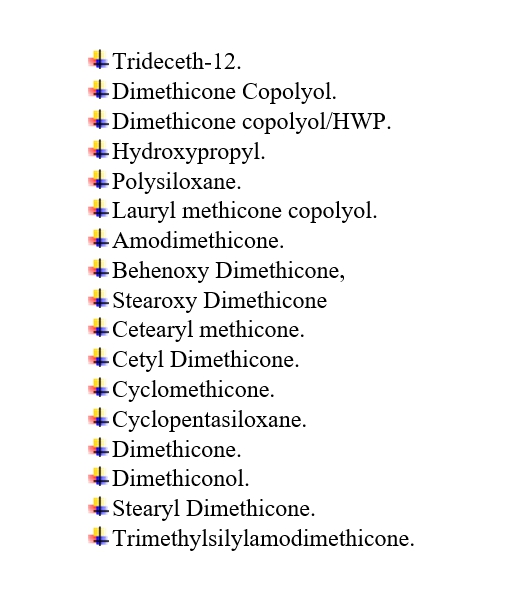
As we have already written, modern chemists know a lot of silicones and listing them all is a crazy idea. But among them there are those that manufacturers like to use especially often. Below is a list of the most popular silicones that are found in shampoo formulations.
Shampoos without silicone 

Since silicone is present in the composition of more than 70% of all products, it becomes more difficult to find high-quality and “clean” shampoo, but the main thing is that they still exist.
Among the products without silicones you can include absolutely the entire line of domestic shampoos and conditioners of the Natura Siberica brand. Moreover, SLS cannot be found among the components of their shampoos, but there are many natural oils, decoctions and other useful elements. Despite all the stories that sulfate-free shampoos do not wash hair well, after using them, the curls are soft and clean. But those who do not wash their hair well are those who have previously used products with silicone. After all, as we have already said, sulfate-free shampoo is not able to wash silicone.
The Japanese cosmetics brand Salon Deapres is also free from harmful chemicals of this kind. And also medicinal shampoos from the LOGONA brand. These are the most common brands, but fortunately, they are not the only ones. Shampoos that do not contain silicone can be found in specialized online stores; such products have a special mark.