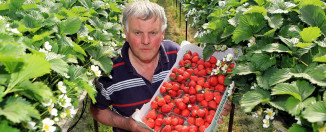
Planting strawberries

You can find wild strawberries in almost every garden plot. People call its garden form strawberries. Gardeners appreciate this berry for its excellent taste and have given it a worthy place in the beds. Subject to certain rules, it will not be difficult to grow strawberries.
Content
Strawberry varieties
The strawberry grown in home gardens is a perennial plant of the pink family. It forms small bushes with stems up to 30 cm in length. Each bush has long, creeping mustache-shoots, with the help of which the plant reproduces. White flowers first appear in May, but the ripening period for berries is different for all varieties. Some varieties strawberries can bear fruit more than once per summer.
Among all the varieties of this culture, the most popular are:

- Wild strawberry has an amazing aroma. This variety is perfectly adapted to any climatic conditions, does not lend itself to diseases and pests, and is very unpretentious to keeping conditions. It blooms in late spring and can be harvested in June. The fruits of this variety are small in size.

- The merchant's strawberry is distinguished by its large and dense burgundy berries. This variety belongs to medium early, its yield is up to 300 grams of berries from one bush. The Kupchikha variety tolerates frosty winters well, does not suffer from powdery mildew and gray rot.

- Strawberry Lord differs from others in that it has very large berries. Good care can provide berries weighing up to 100 grams. The bushes of this strawberry are large in size with powerful stems. Variety Lord is resistant to frost, but at the same time requires shelter for the winter with special material. Diseases and pests are not terrible for this variety.

- Strawberry Elizabeth has a distinctive feature - it gives three harvests in one summer. The berries ripen once a month, and if the plant is properly cared for, the yield can be even higher. The berries have a rich burgundy color, and their weight can reach 100 g. The berries are distinguished by an aromatic sweetish taste, they tolerate storage and transportation well. The variety copes well with frosty winters, is resistant to diseases and pests.
Repair strawberry
The remontant strawberry differs from its wild relative by a long fruiting period. As soon as one harvest of berries ripens, new flowers are immediately formed on the plant and the formation of the next harvest begins. The work of breeders has provided remontant strawberries with numerous beneficial qualities that make it easier to care for them.

Fruiting of remontant strawberries begins half a month earlier than other varieties, and continues until late autumn. The plant is frost resistant. Moreover, even if part of the bush has suffered, new ones grow quickly instead of damaged shoots. Compared to wild strawberries, remontant varieties have larger berries. Fruits can have not only the classic red color, but also white or yellow. All remontant varieties are disease-free and pest-resistant.
At the same time, remontant varieties have some disadvantages. For example, for active fruiting, it is necessary to replant the bushes every three years, otherwise the plant will begin to produce less yield. Such varieties need to create favorable conditions for good fruiting. Remontant varieties are grown only by seedlings.
Planting strawberries in autumn
Before to plant autumn strawberries, you need to choose the right site. This should be a well-lit area, clear of weeds and rhizomes of perennials. Before planting seedlings, it must be dug up onto one shovel bayonet.
The planted bushes must be prepared. To do this, their roots are soaked in water in advance to reanimate. For better survival, you can add the drug Kornevin, a spoonful of honey or juice from an aloe leaf to the water. It is better to cut the roots to a length of 6 cm. This will reduce the period of their recovery, accelerate the growth and development of the bush. No more than three leaves should be left on the seedling. This will reduce moisture loss, disease and other problems.

Strawberries are planted in rows, observing the distance between individual bushes of 25 cm.With weak seedlings, two plants can be placed in one hole. When planting, it is important to place the growth bud correctly. It must be at the same level with the ground, otherwise the plant will not bloom or will lag behind in development.
Before planting, grooves with a depth of 15 cm are made in the garden, watered and brought in ash. The bush is placed in a groove and the roots are sprinkled with earth up to half. Then the remaining roots are watered and covered with dry earth. With this planting method, there is no need to water the plants for up to three days.
Preparing strawberries for winter
Before winter rest, strawberry bushes must be cut off. This procedure is carried out after harvesting. For a future transplant, only one outlet should be left intact, everything else must be removed. Pruning is done with sharp scissors; you cannot pluck the shoots with your hands, so as not to damage the mother plant.
Two months before the onset of frosty weather, the soil is loosened and mulched. If you do loosening later, the root system of the strawberry may not have time to recover before the cold weather.

Another necessary procedure is hilling. It will protect the additional roots that form on the mustache from frost. To do this, these roots are covered with a mixture of earth and peat, while trying not to cover the growth point.
Humus or peat is used for mulching. These substances both fertilize and protect the plant. In this case, it is important to prevent the substance from getting on the plant itself, only the soil should be involved.
Strawberry care
Strawberry plantings should always be clean. This means that old leaves and shoots must be removed in time. Also, for a good harvest, you need to trim off the excess mustache. So it will be more convenient for strawberries look after, and the harvest is easier. In addition, it will protect the plant from gray rot and allow you to harvest large berries. If the plant needs to be propagated, then separate the mother plant and remove the flowers in it, leaving only the mustache.
It is imperative to water the strawberries in a timely manner. The soil must be kept moist at all times. Watering should be done under plants or drip. It is also necessary to mulch the soil with straw, rotted sawdust or cut grass.
Feeding strawberries
The easiest way is to feed strawberry bushes twice a season. The first time this must be done in the spring, the second feeding is carried out after the completion of fruiting. As a top dressing, a combined liquid fertilizer is applied, consisting of 1 liter of mullein, 60 grams of superphosphate, 150 grams of wood ash and 10 liters of water. This solution is enough for three square meters of planting.

A furrow is made along the row of strawberries, where fertilizers are poured. Then the furrow is leveled. After that, the plants are watered with clean water to prevent burns.