Child and temperature: answers to popular questions

An elevated temperature in a child terrifies most mothers and fathers, although this is just a defense mechanism of the body, so you should not try to bring down the fever if the thermometer shows less than 38.5 degrees. But certain rules must be followed for a speedy recovery. Should traditional walks in the fresh air and evening swimming be cancelled? How to bring down the temperature without resorting to medications? You will learn about all this from the article.
Contents
Is it possible to feed a child with a fever?
Most parents are confident that it is possible and necessary to feed their child during illness, even if the child refuses to eat. However, experts have their own opinion on this matter; if you force your baby to eat against his wishes, all his energy will be spent on digesting solid foods instead of fighting the disease. In addition, the child may simply vomit, which will make the condition worse. Therefore, in the first days of illness, you should switch to liquid food, feed often, but in small portions.
How to feed a baby high temperature:
- Food should be simple and light. Oatmeal and buckwheat are suitable for porridges; they are rich in vitamins and microelements so necessary in the fight against viruses and infections. You can cook them with water, broth or milk.
- Low-fat and soft cottage cheese, applesauce do not irritate the gastric mucosa and are quite suitable for feeding, as well as eggs, cookies and croutons.
- Spicy and salty foods increase the pain of a sore throat; you should not abuse them.
- A baby is unlikely to agree to eat meat, fish and poultry during an illness, but they are needed during the recovery stage. The same applies to fruits.
Warm drinks are allowed in any quantity and as often as possible. Sweet weak tea, infusion of rosehip and chamomile, dried fruit compote will give the child strength, but it is better to avoid juices for a while or use them in diluted form. Be especially careful with citrus fruits, they can cause allergies. A separate issue is milk. It cannot be definitely recommended or prohibited; it all depends on the reaction of the baby’s body. 
Is it possible for a child to walk with a fever in the summer?
Of course, at the beginning of the disease, when the child is weak, his tone is reduced, there is high temperature and vomiting, you should avoid walking in both winter and summer, limit yourself to ventilating the premises. But during the recovery period, small children are usually quite active, play and eat well, then feel free to go outside, but make sure that the baby does not strain too much, engage him in quiet activities in the fresh air away from roads and transport, a forest or park is ideal in this case. 
Other rules:
- Walking should be avoided if there is mud, rain or hail outside; limit yourself to just going out onto the balcony. On hot days, move the promenade to earlier in the morning.
- Dress your baby according to the weather; the fabric should be breathable and not create a greenhouse effect.
- Reduce your walking time to avoid fatigue, overheating or hypothermia.

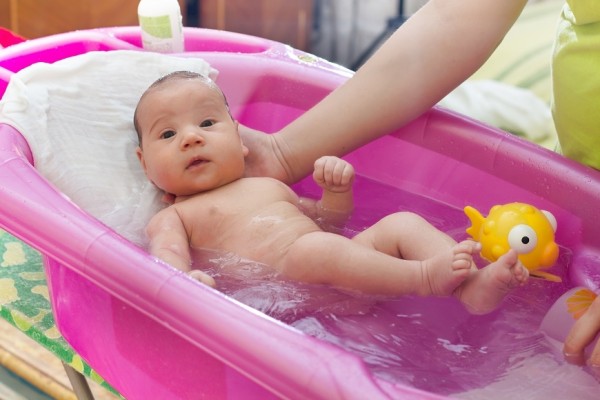
Is it possible to bathe a child with fever?
This is perhaps one of the most common questions when it comes to fever in a child. Grandmothers will loudly claim that swimming very dangerous, the baby can easily catch a cold, as a result of which the illness will worsen. This really has to do with reality, just not modern, but Soviet, when not everyone had favorable conditions for washing a child.
Nowadays, pediatricians are unanimous - you can bathe a child, but under certain conditions:
- In the first days of illness, you should not torment your child; it is better to let him sleep and mobilize his immune system.
- Even in satisfactory condition, if the baby has a stuffy nose, bathing will only increase the discomfort.
- Washing a child should be limited only to the need for hygienic procedures and removal of contaminants, and it is better to avoid prolonged water fun.
- Make sure that the water temperature is comfortable - barely warm, then the child will feel better.
- Avoid drafts and wipe your baby dry.

Is it possible to do inhalations for children with fever?
Infectious and viral diseases are almost always accompanied by inflammation of the respiratory tract and nasopharynx, as a result of which the child develops a runny nose, nasal congestion, cough and shortness of breath. In this situation inhalation can be a good way out of the situation, but what if the illness occurs against the background of elevated body temperature?
To begin with, let’s make a reservation that the inhalation procedure is carried out in two main ways - with the help of steam, when the medicine enters the respiratory tract and has a vasodilating effect, and thanks to a special device, a nebulizer, it sprays the drug into the respiratory tract.
It is the second method that can be used to inhale a child whose body temperature is above 37 degrees, because exposure to hot steam can only increase the fever. If we talk about the upper temperature limits, then at 38 degrees and above, inhalation is not recommended even with the help of a nebulizer, although there are exceptions to this rule.

Is it possible to rub a child with a fever?
Let's start with the fact that the child's temperature should be brought down only when it exceeds 38.5 degrees; until this moment, the body must independently fight the disease. But there are times when you need to act immediately, for example, if the baby has heart and lung diseases or is prone to seizures.
When the thermometer rises to 39, you need to call an ambulance and give an antipyretic. In such a situation, many parents remember the old grandfather’s method - rubbing with vodka, however, there are those who are skeptical about this method. The mechanism of action is based on the unique property of ethyl alcohol; it quickly evaporates, while helping to enhance heat transfer from the body and reduce the temperature. The disadvantage of this method is the high toxicity of vodka, especially since its quality may not be the best, and vapor poisoning leads to dire consequences.