“Water procedures”: how to bathe a newborn

The baby's first bath is an important and exciting moment for new parents. Therefore, many mothers and fathers often wonder how to do everything right so that child Have you loved water procedures since infancy? Our article will help answer it.
Contents
When can you bathe your baby?

It is necessary to bathe the baby for the first time on the day returning home from the hospital to wash off the “hospital” microflora from it. This procedure should then be carried out daily, and preferably at the same time, before feeding.
Why is it so important to wash baby every day? The fact is that newborns often burp, go to the toilet, and sweat a lot, while the surface of their delicate skin becomes dirty, which can result in such troubles as “prickly heat” and diaper rash.
Many parents are afraid to bathe their baby if the umbilical wound has not yet healed (this happens only 18-22 days after birth). There is nothing to worry about here, you just need to follow the following rules:
- the water must be boiled;
- the baby bath should be cleaned with soda and scalded with boiling water;
- You need to add a couple of drops of a concentrated solution of potassium permanganate to the water so that it turns pale pink;
- After water procedures, be sure to treat the wound with hydrogen peroxide and brilliant green.
Water temperature for bathing a newborn
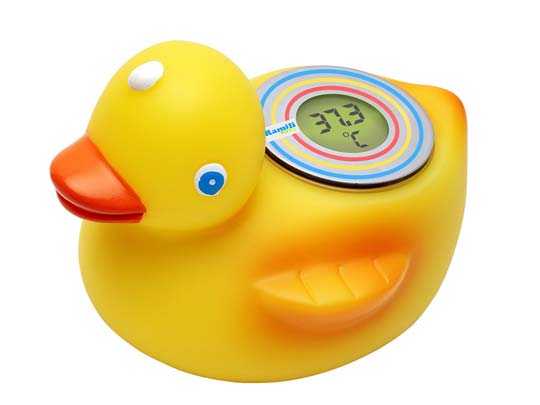
It is believed that the water temperature suitable for swimming should be 37 degrees, although everything here is individual for each baby. Some begin to freeze and shrink into a ball, while others become too hot - they turn red and begin to act up. Therefore, after observing the child’s behavior, parents will understand what temperature will be comfortable for him.
It is very important to use a special thermometer for these purposes and measure the temperature only by completely immersing it in water. If you don’t have it at hand, then you can put your elbow in the bath - it should feel neither hot nor cold. But it’s still better to use a thermometer!
Bathing a newborn baby
The first step is to organize all the conditions for carrying out water procedures: prepare the room, towels, diapers, and means for bathing the baby, which are used from the first days of life.
A baby bath can be installed in the bathroom or kitchen, the main thing is that parents have the opportunity to approach it from any side. The optimal air temperature is not lower than 24 degrees, and the absence of drafts is also very important. The water level in the bath should not exceed 15-20 cm, and potassium permanganate should be added for disinfection. Often, a diaper or towel is placed on the bottom to prevent slipping, or a special chaise lounge is placed. Be sure to prepare a jug with a volume of about 2 liters, with the same water for dousing the child at the end.
It is most convenient for two people to bathe the baby - one will hold him and wash him, and the other will give him everything he needs. All this time, do not forget to talk to him calmly and affectionately.
So, let's get started. You need to undress the baby, wrap him in a diaper, and carefully lower him into the water. This way he will feel more protected, as he did just recently in his mother’s belly. Although some parents manage without it. In this case, it is important to properly support the child with one hand so that his head and shoulders remain above the water, and with the other, alternately soap all parts of the body, starting with the head. To wash the back, carefully turn the baby onto his stomach. Finally, rinse it out of the jug to remove any remaining scum.
Then you can take the baby out of the bath - remove the wet diaper if he bathed in it, and wrap it in a dry one, wrap it with a towel on top and take it to the changing table.
Post-swim care
 All necessary care products, as well as clothing, should be prepared in advance. It will be convenient to immediately arrange them in the order in which they will be needed.
After the bath, it is very important to thoroughly dry the baby’s hair and skin with a soft towel or diaper, especially all the folds: behind the ears, neck, armpits, folds on the arms and legs, and in the groin area. Then they need to be thoroughly lubricated with a cotton swab dipped in boiled vegetable oil or use baby powder.
Next comes the treatment of the umbilical wound: using a pipette, first drop 2-3 drops of hydrogen peroxide on it, and then 1-2 drops of brilliant green and wait until it dries.

If there is diaper rash on a child’s skin, then dexpanthenol-based creams will help to quickly deal with them.
That's all, now you can dress and feed the baby.
A few words about clothes. The best option is a cotton vest with front clasps, a diaper and swaddling wrap. It happens that the baby does not want to be constrained by diapers, then a piece of overalls - a “slip” - will be a replacement. Be sure to put the cap on your head until your hair is dry.
Do not forget that water procedures relax and calm the newborn, so it is best to carry them out in the evening before bed.