Signs of ear mites in cats

Ear tick- the most common disease pets. Fortunately, it can be detected and treated at home. Read on to learn how to help your four-legged friend get rid of the blood-sucking animal.
Symptoms of ear mites in cats
Favorite place for ticks - ears animals. After the “unwanted guest” sneaks into the “den,” the fluffy one experiences inflammation and contamination of the hearing aid with sulfur, as well as itching and scabies. 
To notice an infection, you need to monitor the behavior and condition of the four-legged:
- the pet becomes restless, often meows and rubs against the owner while its muzzle tilts to the side;
- the cat rubs its ears against various objects with special zeal;
- After a while, specific pus appears in the affected area;
- A crust forms inside and around the ears.
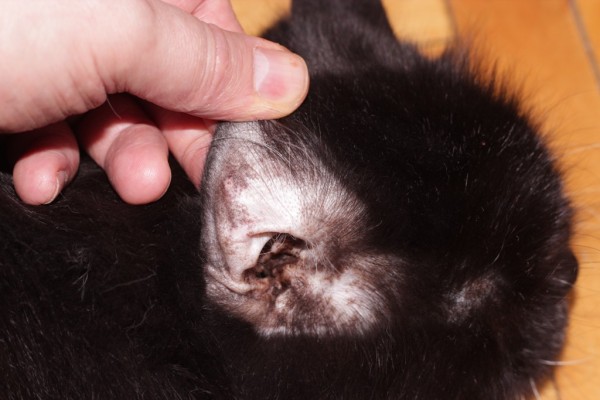

If left untreated, the inner and middle ear are affected, and then the brain. The symptoms are as follows:
- depressed mood;
- high body temperature;
- crooked head (the cat tilts its head towards the infected ear).
All this can end in a seizure from which the cat dies. To prevent this from happening, at the first appearance of the disease - Contact your doctor and start treatment immediately. Before starting treatment it is necessary to understand the causes of infection. A pet can become a “house” for a tick after contact with a sick animal, or due to contact with affected objects, this could be dishes, a rug or hygiene items. A tick can be brought into an apartment from outside, especially if ownerless animals live in the entrance. Flies and fleas are also carriers of arachnids.
Treatment of ear mites in cats
28648173333_bd724def6c_b-e1473871538724 Before you start getting rid of ticks on your own, you need to contact a specialist, because... There are other diseases with similar symptoms. During the examination, the doctor will carefully examine the pet’s ears with a special instrument and, if necessary, use a microscope. If " 
" confirmed, doctor prescribes {!LANG-956adcecc44612077c9e762343cdcdcc!} {!LANG-e70515deff05e0d6dfb2457cff45bfcc!} course of treatment. It consists of washing the ears with an antiseptic, pouring liquid medicine into the ears using a syringe, and it is also necessary to drip the infected organs with a special medicine (it is extremely necessary to observe the dosage, since the poison, which is aimed at exterminating bloodsuckers, can negatively affect the patient’s health). 
You can also get rid of “guests” using:
- ointments and gels that are applied using cotton pads or ear swabs, this must be done with extreme caution so as not to damage the ear;
- special powder, which must be poured in a certain amount into the affected organ, then gently massage the base of the ear;
- spray/aerosol, which must be sprayed at a short distance from the ear for two seconds, necessary so that the medicine gets to the infected areas;
- drops to be applied to the mane.
Treatment takes place in several stages lasting several days ( exact information is provided in the instructions) every five days ( how many days does a tick live).
Preventing ear mites in cats
A pet's illness is stressful, both for the animal and for the owner. To protect your pet from ticks you need to:
- limit the cat’s contact with stray animals;
- examine your pet’s ears to detect infection early;
- clean ears if they are visible;
- treat your hearing aid monthly using special products; they are safe for four-legged animals and can also be used to clean ears kittens and pregnant cats.