How to learn to understand people

Understanding is the main key to success in human relationships. If a marriage breaks up, conflicts occur at work, communication with friends or relatives stops, we usually say that there is a loss of understanding. This means that for some reason two people have moved away from each other or hostility has arisen between them. How to avoid this and learn to understand your loved ones?
Contents
What does it mean to understand a person?
Understanding - the most important category in the relationship between people, cultures and even entire countries. In philosophy, this concept is interpreted as the ability to present and perceive information and messages; this can also include general information about the subject, the surrounding and internal world. Therefore, if you really want to understand your loved ones, first of all, learn how to correctly present, perceive and interpret information. Any success, whether at home or at work, is based on establishing contact between two individuals, and since all people have different personalities and temperaments, this is sometimes difficult to do. Of course, at the level of intuition, we feel when it is worth remaining silent or supporting with advice. It is this quality of personality that allows one to achieve understanding, that is, to pass through the motives, actions and behavior of another person, to draw the right conclusion and act appropriately. Psychologists have developed several special techniques, once mastered, you will learn to understand others.
The ability to understand is influenced by many factors, first of all, the emotional background, in other words, the mood. To achieve harmony in relationships with both adults and children, you need to treat everyone with kindness and respect, then this will evoke reciprocal feelings, because understanding is what is valued most in the family or communicating with colleagues, all parties are interested in establishing connections. 
How to understand your loved one
First, let’s dispel the illusions of many women about the ideality of relationships. Most ladies dream of a prince on a white horse who will come rushing in and everything will work out for them like in a fairy tale. This is extremely rare in life; it is likely that both the guy and the girl will have a difficult character, bad habits and diametrically opposed points of view on some aspects of life. You are confident that you are doing everything possible for the relationship, trying your best, but you come across a wall of misunderstanding. Try to look at the situation with different eyes; most likely, your significant other has a completely different opinion.
Practical tips for achieving understanding:
- Try talking to your loved one about how you first met, first dates and their details. It may turn out that he remembers those nuances that you forgot about.
- Analyze different situations together more often, find out his opinion and note where exactly you disagree. There is nothing wrong with this, you are a couple, but still completely different people and take for granted the differences in the perception of the world.
- When you show concern for your man, often ask yourself why you are doing this. Perhaps, having advised not to communicate with one of your friends, you are not worried about him, but about yourself. Try to accept your loved one’s right to their own point of view and personal territory.
- Don't make fun of your spouse's hobbies, even if they seem useless and funny to you. Once you understand that your lover’s hobby brings him true satisfaction, you will find many advantages in it.
- Constant criticism of your loved one will only lead to a permanent state of cold war. In disputes, sometimes it is better to force yourself to close your mouth and not try to convince or impose an opinion. Wait until the man himself makes a decision; if the problem is resolved in a positive way, find the strength to admit that he is right.
- Whatever you do, always ask yourself what these actions are aimed at - to worsen or improve the relationship? Then everything will fall into place.
- No matter how offensive it may be, watch your speech and do not make harsh statements or insults towards your opponent. You will achieve your goal and touch a nerve, and this greatly undermines trust in a couple.
- Do not torment your spouse with jealousy and mistrust, because you may be wrong about this, thereby hurting your loved one.
- Do not be too intrusive; remember that you live with an adult who is able to take responsibility for himself.


How to understand another person
To learn to understand other people, make it a rule not to perceive events and phenomena only through the prism of your own views and beliefs. Sometimes this can be very difficult; if you are still able to understand one person, then the other is a complete mystery to you due to differences in opinions.
- When talking with a person, be collected and attentive, pay attention to facial expressions, gestures, manner of speaking and other signals that will help you understand the true motives of his behavior.
- Try to mentally formulate a word or phrase that clearly characterizes the internal state of your interlocutor at the moment.
- If your goal is to win over a person, discreetly and unobtrusively copy his postures, gestures and breathing rhythm, the interlocutor will definitely notice this and on a subconscious level will speak more openly.
- Misinterpretation of someone’s words is the main problem in establishing relationships between two people, so don’t overthink it, but ask questions that interest you directly.
- Before drawing conclusions about a person, find out from third parties at least something about his life - profession, family, social circle, such information will give a complete picture and explain many things.
- Watch quality films about ideals, morality and mutual assistance, read classic works, this will help you understand the nature and psychology of people.
- Communicate as often as possible with those who find themselves in difficult life situations, visit sick hospices, orphanages, even animal shelters, believe me, you will discover a lot of new things.
- Listen to older people and don’t ignore their opinions; life experience allows them to look at a situation or problem from a different perspective.
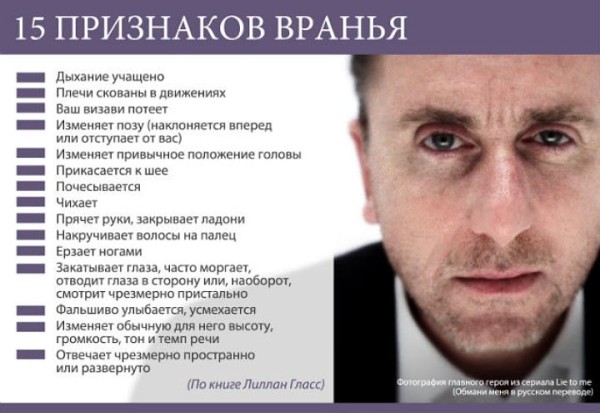

How to understand that a person is lying
It is quite difficult to immediately understand whether a person is telling the truth or not. He can lie selflessly and quite convincingly, but his gestures, facial expressions and manner of speech will sooner or later give him away. Knowing about some psychological techniques and methods, you can easily expose a liar.
- Take a close look at the interlocutor; his eyes can tell about his sincerity. Psychologists believe that if a person looks up while talking to you, it means he is remembering something, that is, he is turning to visual memory. But moving the gaze to the right and down indicates an internal monologue and careful selection of words. Body language is very important here, twitching a shoulder or leg, taking a step back, lifting your chin - all this is also a warning sign.
- It is possible to expose a deceiver by observing him gestures. A person can tell something with interest and gesticulate, trying to captivate you, and at the same time shake his head from side to side, as if disagreeing with himself. Other signs of lying include regularly touching the lips, neck and nose, clasping one's fingers, or stroking one hand with the other (a gesture of self-soothing).
- Trying to mislead, the interlocutor often deviates from the main topic and talks about all sorts of nonsense, stretching out time and wondering whether to tell the truth. Ask him a direct question, most likely he will become confused and admit to deception.
- To find out the information you need, do not warn the person that the conversation will take place. Go beyond the standard script, ask the same unexpected questions, change their wording periodically.
- Never post everything you know at once, use leading questions; when there is enough information, you can compare it with the information you know.