How to take a steam bath

What Russian doesn't like to take a steam bath in a good bathhouse? For most, the process of steaming is nothing more than relaxation, but in fact, the bathhouse brings great benefits to our body. Read on to learn how to properly steam in a bathhouse, why it is useful, why it is harmful, and whether there are any contraindications.
Contents
The benefits and harms of baths

Going to the bathhouse has a comprehensive positive effect on the body, of course, provided that the person has no contraindications, but more on that later, now let’s look at the pros and cons of the steam room.
First of all, the positive effect is, naturally, on the skin. There are many types of baths, so to get the maximum benefit, you need to choose the right one for yourself. For example, for dry and a sensitive dermis, a Turkish steam room will be optimal, for a normal one - a Finnish one, etc. Going to the sauna makes your skin look younger: smoothes out fine wrinkles, cleanses, removes a layer of dead skin cells through the pores of the skin toxins and waste come out. Regular sessions make the skin elastic and toned. High temperatures help destroy harmful microorganisms on the body. Thanks to the baths you can significantly prolong youth skin, normalize the functioning of the sebaceous glands. And what can I say, if you take honey with you to the bathhouse and smear it on your body before the steam room - mmm... the skin will thank you three times for this with its velvety and tenderness.
A bathhouse is stressful for the body, although beneficial, when the body temperature rises by 10°C, and the internal organs warm up by 3°C. If for the person himself such an increase has a pleasant effect, then for the viruses and bacteria that lurk inside it is destructive. Due to this increase in temperature, metabolism accelerates, interferon (antiviral protein) is produced faster, body cells are restored more quickly, and the number of lymphocytes increases. But malignant cells are seriously inhibited in their growth.
The high temperature of the steam room dilates the blood vessels, blood begins to drain from the brain, which reduces its activity and leads to a state of relaxation, for this reason the bath can be “prescribed” for some diseases of the central nervous system. If you alternate low and high temperatures, you can train the elasticity of blood vessels and heart muscle well, thereby reducing the likelihood of a heart attack. In the bathhouse, the vascular system is stimulated, and the pulse rises to 150 beats, the blood begins to circulate more actively, without affecting blood pressure in any way, even the smallest capillaries expand, which helps nourish the skin. Under the influence of a Russian bath, many ailments associated with impaired blood flow, such as varicose veins, are cured.

By increasing sweating, the load on the kidneys is significantly reduced. Interestingly, this effect continues for six hours after going to the steam room. For this reason, the bathhouse acts as a kind of cure for diseases of this organ and, in general, for problems with the urinary system. The procedure has a positive effect on the functioning of the gastrointestinal tract. High temperature has an invigorating effect on the pituitary gland, and it is this gland that regulates the functioning of other glands: the adrenal glands, the thyroid gland, the ovaries and the prostate. Bath returns libido to normal and helps restore sexual desire. And nursing mothers can boast of an increase in milk supply.
Probably everyone has heard about the effect of a bath on the respiratory organs, which begin to actively work and saturate the blood with oxygen, and its arrival is fraught with an increase in the level of joy hormones. The bath helps remove lactic acid and urea, which stagnate in the muscles after physical activity and cause pain. If you choose a suitable broom for the steam room, you can cure sore joints in a short time.
And this is just a small interpretation of the beneficial properties of the bath; in fact, there are many, many of them. The sauna has a versatile effect and has a positive effect on almost all organs and systems of the body. As for the harm, in the absence of contraindications and with the condition of a dosed visit, there is simply no harm. Therefore, before going to the steam room, be sure to check whether you have any diseases that are included in the list of contraindications, or better yet, consult your doctor.
Bath contraindications

Often they like to go to the bathhouse to take a steam bath, taking alcohol with them, but this should never be done - these are incompatible things and instead of benefit, the body receives a huge load, which wears out the internal organs. You can’t go to the sauna on an empty stomach or, conversely, after eating heavily; just before bedtime, it’s also better to avoid the steam room. These are general contraindications that apply to absolutely everyone.
The bathhouse poses a particular risk for heart patients. Despite its positive effect on the heart muscle, the sauna provides preventive measures for a healthy heart, but for those who have problems with it, the steam room can be a real test. The same applies to hypertensive patients, with constant pressure above 200 mm. The bathhouse is contraindicated in case of tuberculosis, the presence of malignant tumors and inflammatory processes of the respiratory system, although at the initial stage of a cold the bathhouse, on the contrary, is indicated and helps prevent the disease. Diseases of the kidneys and liver require mandatory consultation with a doctor, since, for example, kidney stones and nephritis are the strictest contraindications.
It would take a very long time to list all the diseases for which a bathhouse is not the best, or even a dangerous way to relax. Therefore, if you have problems in the areas listed below, you should definitely consult with a specialist about a possible visit to the bathhouse.
- Sore joints and muscles.
- Skin diseases.
- Diseases of the gastrointestinal tract.
- Diseases in an acute stage.
- Fungi.
Under no circumstances should you overload your body with a long stay in the steam room! High temperatures are good, but prolonged exposure leads to overheating, which can have negative consequences. There are clear signs that it’s time to quit steaming and get out into the fresh air, namely:
- nausea;
- dizziness;
- pre-fainting state.
As soon as you feel something is wrong, leave the steam room immediately. It is especially dangerous to be in this state alone in the steam room, as you may simply not reach the door and faint. After leaving the steam room, you need to wash your face with cold (but not ice) water and lie down and wait until your condition returns to normal. Needless to say, on this day you should never go into the steam room again. Don’t joke with your health, such unjustified “willpower” has led to the death of more than one bath attendant.
When to prepare brooms for a bath

The general rules for preparing brooms are as follows:
- Medicinal herbs and bath brooms must be prepared only in clear, dry weather, as soon as the dew has disappeared.
- At the time of collection, you need to carefully handle the plant and cut off only the lower branches, so the plant will not be damaged and will continue to grow.
- To create a broom, only young plants with flexible and well-bending branches are suitable.
- Cut fresh branches need to be dried a little in a dark place for about an hour, spread out in one layer. Be careful, overheating may cause leaves to fall off.
- Tie the broom (you can see how this is done in the diagram below), then place it under the press so that it becomes flat. After this, the finished broom is hung in a well-ventilated and cool room for two to three days.
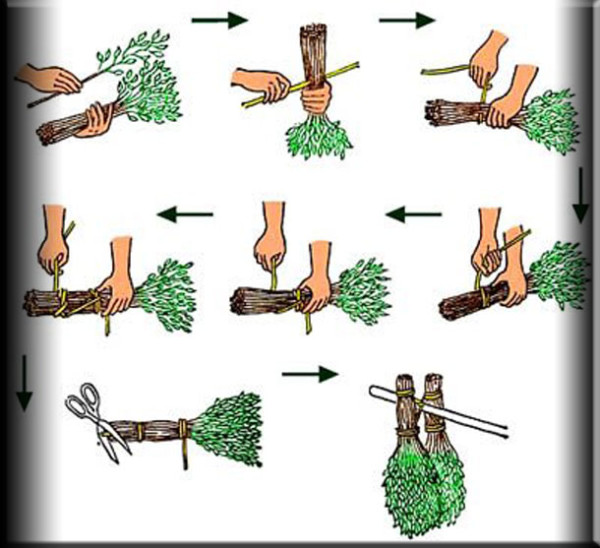

The time when exactly brooms need to be prepared directly depends on what raw materials will be used to create them. Let's consider different options.
- Birch brooms traditionally begin to be prepared in July, at the beginning or middle of the month. The tree from which the branches are cut must be tall and with flowing branches (they also say weeping). But some experts, on the contrary, recommend using young trees for these purposes that have never bloomed before, because they have very flexible branches and delicate leaves. Before cutting branches, check its leaves on your tongue. If the leaves are rough, choose another specimen. But tender and velvety are what you need.
- The collection of oak branches occurs from June to August. The correct place for collection should be dark. Proper assembly will help you create a high-quality broom that will last up to four bath sessions.
- Nettle brooms are prepared in mid-summer, before or at the time of flowering of the plant.
- Cherry and currant brooms are prepared at the very beginning of June.
Brooms from other trees are prepared from the beginning of July to mid-August. Remember, the collection of raw materials for brooms should take place away from the roadway, no closer than three kilometers. Otherwise, the broom will be of no use.
How to steam a bath broom
There are several options for how to properly steam a broom. The simplest and fastest way is to immerse a broom in a bucket of cold water for a couple of minutes, and then soak it in warm water for the same time, but under no circumstances in boiling water. In this case, the basin with the broom needs to be covered so that it steams. The drier the broom, the longer it needs to be left in water. You can tell when a broom is ready by its aroma. which begins to emanate from him. The water in which the bath “tool” was steamed can be used to water hot stones. This will fill the room with a pleasant aroma. It is very important to steam dry brooms. Poorly dried ones can become limp and heavy; they heat up very quickly, which can lead to burns on the skin.
bannyj_venik
How to dry bath brooms

no draft;
- no direct sunlight or brightly lit rooms;
- no high humidity.
- The ideal temperature in the room where brooms are dried is 15-25°C. Do not prepare brooms in an unfavorable atmosphere, such as a garage or utility room. As for how to dry a broom, lying or hanging, there is no definite answer. A lot here depends on the type of broom and the shape you want to get in the end. However, flat ones are considered the most universal. They move more steam, allow more air to be captured and are easy to direct. Flat brooms are obtained by “lying down” drying. But if the item is made in order to simply breathe in the aroma of leaves, then you can make voluminous brooms that are dried by hanging.
If desired, the drying process can be combined. First, fold the brooms for a couple of days, turning them regularly (this will make the shape uniform), and then, when the shape is flat, hang it for a week or two.
{!LANG-7b6733ec4560c800238740312a24f0c6!}
The drying time also depends on the type of raw material. So, for example, birch needs a couple of weeks, while oak brooms require one and a half to two more weeks, and maple brooms generally take the longest.
How to take a steam bath with a broom

At least two people go to the bathhouse to take a steam bath with a broom. The one who will be soaring lies down, and the one who will be soaring must wear bath mittens on his hands, otherwise calluses cannot be avoided. A bathhouse with a broom is not for everyone, but for some it can become real hard labor. However, in any case, you need to remember the golden rules:
- strict rule - the broom simply must be wet, so periodically it must be moistened with water;
- the “stronger” the temperature (over 60°C), the more carefully you need to work with a broom so as not to get burned by the steam;
- The bathhouse attendant needs to be extremely careful: do not swing too much and do not whip the person who is lying down - the movements should be smooth and lightly touching.
It’s only in the movies that everything looks extremely simple, but in practice, many professional and simply experienced bath attendants will agree that using a broom is a whole science. Let's consider in theory some techniques for soaring with a broom.
One lies down on his stomach and stretches his arms along the body, and the other takes a broom in each hand and begins to stroke the person lying down, moving the brooms from his feet to his head and back. This is repeated several times. If indoors very it is very hot - do not move the broom away from your body. After the preparatory procedure, lift the broom a little near the lower back, grab some air with it and lower it onto your back, pressing it with your hand for three seconds. This technique is called a compress. It will be very useful after physical activity and for pain in the joints, injuries and radiculitis.
When problems affect the lumbosacral region, you can use the “stretching” technique. In this case, both brooms are placed on the lower back and moved in different directions, one to the feet, the other to the shoulder blades, and then in the opposite direction to meet each other. It is very important that the brooms do not come off the body. If the room is very hot, then you need to use the broom carefully, without rushing.
The “quilting” technique is performed with the ends of a broom, making light quilting in all directions along the hips, pelvis, calves, lower back and feet. The duration is about a minute, and the reception ends with stroking.
After the described manipulations, lying on the stomach, the person is placed on his back and everything is repeated.
{!LANG-52c7a19767defa945494ef25011aff9d!}
A stronger technique is called “whip” - the broom is raised up, air is captured and a couple of whips are performed on different parts of the body with a compress applied for three to four seconds.
Plowing is performed with a light wave of the broom and a very weak, barely perceptible touch to the body, in this case the “lying person” feels a pleasant hot breeze. If you need it hotter, just raise the broom higher.
Complete the procedure with a broom by simply rubbing. With one hand you need to hold the broom by the handle, and with the other lightly press down the leaves of the broom and thereby rub the entire body. The arms and legs are rubbed lengthwise, and the torso in all directions.
After all the manipulations, you need to get up very slowly and carefully, otherwise you may feel dizzy.
How to take a steam bath correctly

Visiting a bathhouse can be a pleasure and “fix” your body only if you do it correctly. It would seem that what is so difficult here? In principle, nothing, but you need to know about some nuances. Let's look at the entire vaping process “from” to “to”.
- Stage one is preparation. Before taking a bath, you must wash yourself; just rinse with water at a temperature of 38°C. The purpose of the procedure is to warm up the body. There is no need to use soap and a washcloth, as this will wash away the lipid layer that acts as a barrier. Otherwise, the high temperature in the bath will dry out the skin. You can pamper yourself with soap and a washcloth after the bath. Don't get your hair wet either, so you don't get heatstroke later. It’s even better to wear a special cap in the bathhouse, which is better to moisten it a little in water. That's all, now you are absolutely ready to enter the steam room, of which there are usually five to seven.
- Stage two is adaptation. The first visit to the bathhouse is used to get used to the high temperatures, so you don’t use a broom, but you take it with you for a good steam. To warm up the body, a temperature of about 60°C is suitable, so it is better to sit on the first shelf. Lie down, relax. After a little time, sweat will begin to appear, the heart will beat faster, the skin will turn red - this has begun the adaptation process. The first approach should take about ten minutes, no more.
- The friction stage is heat. The duration of the second approach is about a quarter of an hour. This time you can use a broom or just lie down.
- Stage four - repeated visits. During subsequent visits, and, as we have already said, there are usually at least five of them, the temperature in the steam room can be raised. The maximum length of stay in the bathhouse should not exceed 25 minutes, while being attentive to your feelings, and if you feel unwell, leave, never sit forcefully.
Particular attention should be paid to the rest between sessions. The duration of these should be no less than the duration of the visits. Fans of baths use these intervals for contrasting procedures: for example, jumping into a font, an ice hole, dousing yourself with cold water or wiping yourself with snow. However, if your experience of going to the bathhouse is not so rich, then it is better to leave this for the future. And you can start by standing in the shower after the steam room with a water temperature of 25°C. Procedure hardening you need to start gradually. If you are not in the mood for hardening, then you can wrap yourself in a towel, sit quietly and drink tea.
How often can you go to the bathhouse?
Going to the bathhouse is so pleasant that it can be very addictive, but everything, even the best and most useful, should be in moderation.
In many countries where bath culture is actively developed, people go to the steam room almost every day. However, medical experts do not share such views at all. In their opinion, visiting the bathhouse should be no more than once a week. In principle, such an opinion is quite justified. After all, a bath is, first of all, stress for the body, which has a positive effect on health. However, if such stress occurs daily, instead of benefit, it can cause harm.