Easter holiday: traditions, rituals, celebrations, recipes

Easter is a fairly ancient holiday, whose origins date back to the Old Testament. We are preparing for this day very carefully, accompanying the preparation not only with culinary masterpieces, but also with other things that we are talking about today. What traditions originated, how to celebrate the Resurrection of Christ and where Easter came from - read in our article.
Contents
The essence of Easter
To get it right celebrate Easter, you need to understand where the tradition of celebration came from and what it symbolizes. So, first, a little background.
The name “Passover” itself is a creation of the Hebrew “Pesach”, which literally means “to pass by” or “to pass by.” Easter dates back to the Old Testament. In the 13th century BC. The Jewish people were enslaved by the pharaohs. The Egyptians feared that the Jewish people would become very numerous and they would overthrow the Egyptians by force. Therefore, Pharaoh ordered that the Jews be treated as harshly as possible, loaded with the most difficult and dirty work, and infant boys generally killed.
Wanting to save their baby’s life, the Jewish family hid the baby from the Egyptians, but when the child turned 3 months old, it became increasingly difficult to hide him. So the mother put the baby in a basket and took him to the reed thickets, and placed his older sister nearby to keep an eye on him.
At that time, the daughter of Pharaoh went to the river to swim and noticed a basket with a child, realizing that it was a child of the Jews, she took pity and took him in to raise her. The little one's name was Moses. The child grew up, but did not lose his spiritual kinship.
Walking through the yard one day, he saw an Egyptian severely beating a Jew. Unable to bear it, he decided to defend the latter and killed the Egyptian in anger. To avoid the execution that threatened him for such an act, he fled the country. There he got married and lived a quiet life herding sheep.
But one fine day he noticed how a thorn tree was burning nearby and did not burn out. Surprised, he approached him and heard the voice of God, who told him that he would grant freedom to the Jewish people, but for this Moses needed to go back.
For cruelty, God decided to send nine great disasters to the Egyptian people, but so that they would not befall the Jews, the latter were ordered to slaughter an immaculate lamb, cook the meat with bitter herbs and eat it, and smear the doorposts with the blood of the animal. Grief entered every door that was not marked with a bloody seal.
On that wonderful night, the people were saved from a long and terrible slavery. In memory of the happy event, a holiday called Easter was established. It is on this day that all Jews around the world cook lamb and bake delicious aromatic bread.
Christian people celebrate Easter according to the new covenant. The New Testament Passover professes the type of Christ, which personifies the lamb. He took upon himself all sins and, in the name of saving the people and giving them eternal life, sacrificed himself. Christian traditions celebrate the Resurrection of Christ, the day on which Jesus rose from the dead.
Now that you know the background, you can understand the essence of the holiday itself. Easter symbolizes freedom and eternal life. These are two wonderful reasons to celebrate Easter, following all the traditions and rules that have developed over many centuries of human life.

How is the date of Easter chosen?
Easter never falls on the same day of the month. There is also an interesting story about how Easter is calculated. In the period until 325, Christian Easter was celebrated on the same basis as Jewish Easter. But then, in the same 4th century, in Nicaea it was decided that the celebration should fall on the nearest Sunday following the spring equinox and full moon. But there is one important addition: the Passover of Christians under no circumstances should fall on the Jewish date.
Based on this, it is clear that the date of Easter is directly related to the lunar and solar calendar. The Christian Church calculates the day of celebration according to the Julian calendar. You can find out the date of the celebration yourself by making calculations using the diagram below.
How to calculate the date of Easter
- First you need to determine the date of the spring equinox (this is when the lengths of day and night are equal). As a rule, this falls on the 21st or 22nd of March.
- Then, looking at the lunar calendar, you should determine when the first full moon will occur, from the day of the equinox.
- Determine the date of the first Sunday following the first full moon. This date will be considered Easter.
As you can see, this is not difficult to do; you just need to have three calendars on hand: lunar, solar and ordinary.
Easter traditions
Such a bright and spring holiday is rich not only in its history, but also in traditions. We will consider the most popular ones, which have been observed for centuries, below.
Easter service

On the day of the holiday, the most solemn service takes place in churches, formed in the first centuries of the birth of Christianity. After a long period of strict fasting, many were baptized and continue to do so to this day. The peculiarity of the Easter service is that it takes place under the sacrament of night and continues until dawn.
Easter greeting
From the holiday night and for forty days, it is customary to christen, that is, not just say hello, but with a smile on your lips, inspired to say “Christ is Risen,” receiving the answer “Truly is Risen.” This is followed by the obligatory triple kiss. Kissing is believed to be so sacred and brings happiness.
Easter fire

Fire plays a fundamental role in Easter rituals and national celebrations. Symbolizing God's Light, it received a second name - Holy Fire. Each of the believers this night wants to get it and bring it to their home.
The fire begins its journey from the soil of Jerusalem and, covering a rather long path, ends up in the cities of Russia and other countries. Christians make every effort to ensure that the blessed fire brought into the house burns throughout the year.
Before the revolution, both in Russia and in the West, it was customary to light large bonfires on church grounds. Unfortunately, due to the growing number of cities and the population density in them, this wonderful tradition has practically sunk into oblivion. However, in small villages and hamlets, people continue to observe traditional lighting to this day. This is a symbol of the burning of the traitor Judas, but the fire was mainly intended for parishioners who could warm themselves next to it after the service.
Easter meal

On Holy Saturday, as well as after the completion of the solemn service, churches begin to illuminate Easter cakes, eggs, Easter and other dishes.
In Christian Easter it is necessary to bake Easter cakes and prepare Easter. However, in southern countries to this day a tradition is observed that requires slaughtering and cooking a lamb for the meal.
They strive to complete culinary preparations by Maundy Thursday, so that there is no reason to be distracted during Good Friday, which symbolizes the removal of the relics of the Holy Shroud and long prayers.
Procession of the Cross

On the eve of Easter, all believers gather near the walls of churches and at exactly midnight they make a procession with prayer chants. This tradition should not be confused with the historical event of the Crusade.
Each country has additional traditions that accompany worship. For example, in Greece, parishioners, waiting for the moment of Easter, begin to make a loud noise, rattling sticks on the stairs. This action symbolizes the earthquake that occurred in Jerusalem at the moment of the removal of the stone from the tomb of Jesus during the Resurrection.
Folk customs and traditions

On the territory of Russia, within the church yard, folk festivities begin on Easter evening. Round dances, songs, dances, swing rides. The celebration continues for up to three weeks. This period got its name - “Red Hill”.
In the cities of Bulgaria at this time, clay pots, made and painted in advance, are dropped from high-rise buildings. This is a symbol of the victory of good over evil and life over death. Passers-by can pick up a piece of broken dishes for themselves, for good luck.
These days all grievances are forgiven. Sorrows and troubles go away, and in return comes peace and happiness.
Easter brings with it a lot of children's fun. The young population competes on eggs. One of the popular pastimes is rides. The meaning is simple - two eggs were pushing at the same time, whose one rolls further wins.
The adults rolled the eggs on the ground. It was and is still believed to this day that the land will then become fertile and will bring a rich harvest this year.
In Western countries, as well as in North America, it is customary to hide eggs early in the morning, and when children wake up, barely having time to open their eyes, they begin to look for them throughout the house with enviable enthusiasm. Kids think that the Easter bunny, which is considered a symbol of fertility and wealth in these countries, is hiding them at night.
In many countries, it is customary to pour yourself on this day. Water brings happiness and washes away all sins. But being dry is a bad sign. In France, on festive Monday, beatings of husbands by wives are practiced, not seriously, of course, but as a joke, but on Tuesday, men respond in kind to their loved ones.
In European countries, as well as Australia, Easter is celebrated at the state level and is marked as a holiday. For students and schoolchildren this is a vacation period.
Fasting before Easter
The fast before Easter is considered the longest and strictest, therefore it is called Great Lent. It lasts exactly 40 days from the end of Maslenitsa. The deadline is set for a reason. It is believed that this is how long the Savior walked through the desert, going through temptations prepared by the devil, and not eating food. The last week of Lent plays a special role in Lent, commemorating the end of the earthly life of Christ and the torment before death.
The first Monday is characterized by a complete refusal of food. On this day you can only drink water. On other days the following rules apply:
- on Mondays, Wednesdays, and Fridays, dry eating occurs, when the consumption of water, bread, fruits, vegetables and compotes is allowed;
- on Tuesday and Thursday, hot food is eaten, but without oil;
- In the remaining days, food is consumed with vegetable oil.
On major holidays that fall on Easter, you can enjoy fish and fish caviar. But on Good Friday you cannot eat anything until the removal of the shroud occurs.
How to tell children about Easter

At a conscious age, every child in a Christian family knows about the existence of the holiday of Easter. He knows that this is a very good and kind day, when everyone is happy and having fun, but, of course, he does not understand why all this is happening. The question arises of how to correctly and most clearly tell the whole story to the baby so that he understands everything.
Children initially have a creative approach to the perception of absolutely any information. Therefore, trying to explain something in words, you are unlikely to achieve the desired effect. It's much easier to go the other way. In church shops, and even on the shelves of ordinary bookstores, you will find a large amount of children's literature dedicated to Easter.
The authors of the works present the history of the holiday in a language accessible to children, accompanying their narrative with fascinating pictures. On a cozy evening, sit with your baby on the bed and read a book together, discussing each picture.
Looking at the images, the baby will definitely understand everything and have a complete understanding of how Easter appeared, what it symbolizes and why all people are so happy about its arrival.
Easter songs
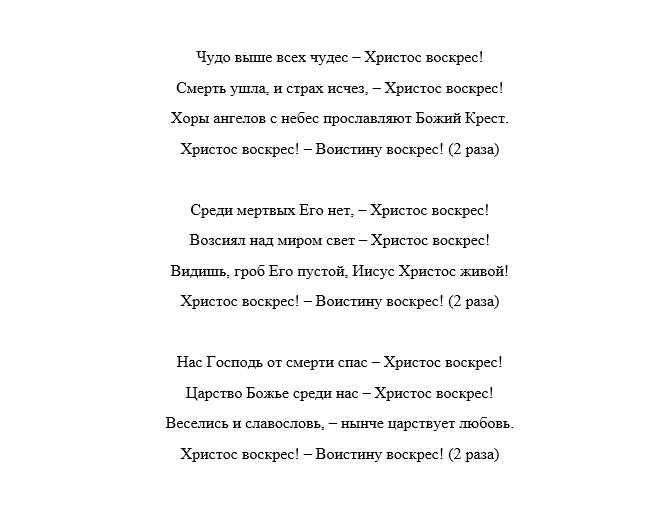
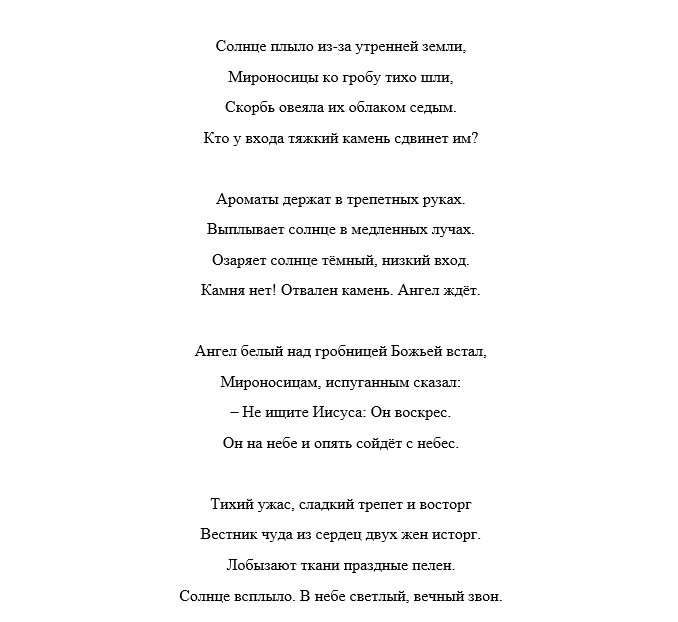
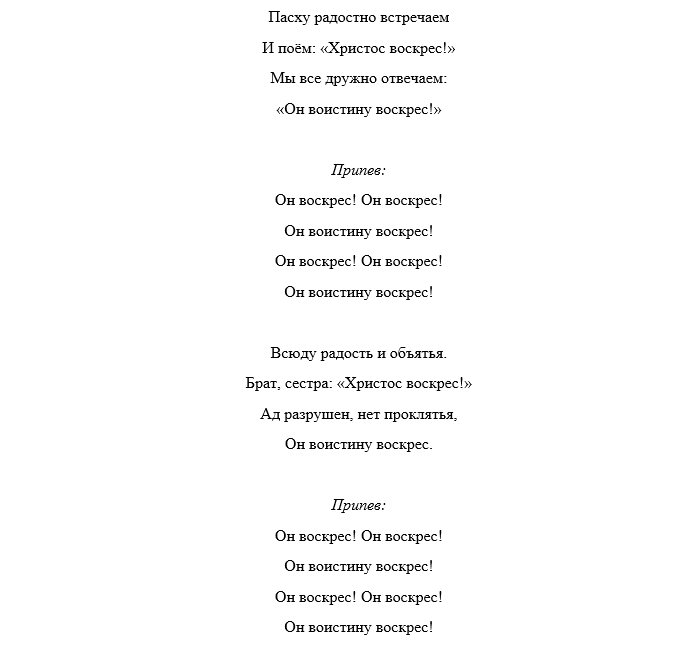
Since Easter is a holiday of fun, it must have songs. We present to your attention several Easter hymns.
Gifts for Easter

First of all, the symbols of Easter are the rabbit and eggs, so they are among the main gifts on this day.
Interesting fact. In traditional icon painting, a halo is always depicted around the heads of saints, which is the fundamental reason for the symbolism of the egg.
For children there are chocolate bunnies, soft toys and souvenir bunnies with eggs.
For the adult population, in principle, any things that have the appropriate symbolism are suitable. These could be robes or slippers with rabbit ears, jewelry, ties and other things that have either the shape or pattern of a rabbit or eggs.
The main rule of a gift is durability, so that it reminds its owner for a long time about a bright day and happy moments of the holiday.
A practical, beautiful and original gift for Easter – salt and pepper shakers in the shape of eggs.
However, despite such a wide choice of gifts, Christianity has an unshakable tradition of giving eggs. It’s great if it’s prepared with your own hands. You can use a little imagination and create a real work of art with your own hands. Below we will present to your attention a wonderful master class that will help you make a lace egg.
DIY Easter crafts
By following the step-by-step recommendations, in the end you will get such a wonderful lace egg. It will be a wonderful decoration for any home and will remind you of a bright and good holiday for a long time.

To create an egg, you will need a plastic mold, the kind that children's surprise toys are usually sold in. Split it in half and make holes on the top of each using an awl. This action is necessary to ensure that the drawing is symmetrical.

From the wrong side, insert needles into the punctures so that the points come out.


Measure the diameter of the egg so that there are 8 identical slices on it. For convenience, attach elastic bands to the needles. Then mark the lines with a felt-tip pen.

Once the lines are drawn, the elastic band can be removed. To make it easier to work with the egg and avoid it rolling on the table, place the mold on a glass or stand in which eggs are sold.

Wrap each of the halves with cling film, having first numbered the halves symmetrically. The egg prepared for work should look like this.

Next, you will need paper strips for quilting. One package of 100 pieces, with strip size 300x1.5 mm. You can choose the color as you wish. It’s worth mentioning right away that each part should be coated with glue in those places where there will be maximum contact with other parts. Make sure that there are no visible glue residues between the parts.
Make one tight paper roll and secure it with a needle at the very top of the egg. The approximate diameter of all rolls, regardless of their shape, is 7 mm. Then twist 8 rolls from ½ strip, giving them a droplet shape (to do this, half the roll will have to be “unraveled,” i.e., loosened). They will just lie along the lines marked on the egg.

The next row consists of the same 8 loose rolls, made from ½ of a strip, but shaped like a circle. Secure with glue.

Next you need to make curls from solid strips of paper. Curls can be formed using an awl; the distance between them is 7 mm.

Carefully glue the entire strip along the diameter of the egg, covering the space between the rolls from the previous row. For ease of work, fix the previous rows of rolls with a needle.

There are 5 rows running down the middle of the egg, consisting of 8 flowers made of 6 petals. You can prepare parts for work in advance or do everything as you go.
To make one row you need to take 16 strips. Each petal is made from 1/3 of the strip. The diameter of the petal is no more than 5 mm. The process is similar to the previous one. Roll it up, loosen it a little and shape it into a drop.

Then the leaves are prepared. To do this, the strips need to be cut into 4 equal parts. The twisted roll opens to a diameter of 5 mm. Use your fingers to create a wave shape. There will be about 16 such “waves” in one row. You need to glue the leaves as shown in the photo.

Don't forget to glue the flowers on the back side. When the glue dries a little, bend the flowers slightly so that they fit as tightly as possible to the egg in shape.

Glue the first row of flowers, securing each of them with a pin in the center.

Similar to the previous steps, glue the remaining two rows of flowers, placing them in a checkerboard pattern.

The top part will hold 3 rad flowers. Continue in this manner, making a fourth row with the same number of flowers. But increase the diameter of the rolls a little so that they can cover the diameter of the egg.

Cut the strip into 4 equal parts and begin folding it using the loop method. Those. at the very beginning, fold 1.5 mm, and then continue to bend the strip, adding 1.5 mm on each side. The result should be 16 strips measuring about 12 mm. Excess strips need to be cut off. The image below clearly shows the sequence of actions.

Fixed fourth row of flowers below the level of the egg connector.

Using gentle movements, separate the egg and remove the tack.

Start working on the bottom of the egg. As at the very beginning, make a tight round roll and secure it with a pin at the very top.

Next, make droplets from the rolls, making them from half a strip of paper. Dissolve to a diameter of 7 mm. You will need 8 pieces. Don't forget to glue them. Only, unlike the top, here the petals are glued with the point down.

Glue round loose rolls between the petals.

Then another row of round rolls.
Place both parts of the egg together. Continue to secure each new row with needles so that the pattern does not move.

Make 8 curls. To do this you will need ¼ of the strip. How to make them can be clearly seen in the image below.

And glue them to the egg as follows.

Next come curls of whole stripes and a row of 8 flowers and 16 petals. They are arranged in the same checkerboard pattern and are made similarly to the previous ones.

The last row is connecting. He is the most responsible. Here you need to try everything on. The petals are made using the loop method you are already familiar with. We made one leaf and tried it on, if it fit, we glued it, if not, we corrected it. But you only need to glue the leaves to the bottom fifth row. Join the fourth one, but do not glue it, you will do this a little later.

Very carefully separate the egg in half. Remove all the pins from the top of the egg and carefully remove the “lace” from the mold. Then stick the needle into the flower that was between levels 1 and 8.

The left needle will serve as a mark for smooth joining.

Repeat the same with the bottom part, leaving the needle in the same place.

Coat the stamp leaves and join both halves. At this stage you need to be patient and wait for the figure to grab.

That's it! The Easter egg is ready, you can enjoy the result.

You can further decorate the egg by placing, for example, rhinestones or beads in the center of each flower.

Easter recipes
At Easter, it is customary to prepare two main dishes: cottage cheese Easter and Easter cake. However, this does not mean that other dishes are prohibited. On the contrary, the more varied your table is, the better. As such, there are no Easter recipes, and under their guise, ordinary dishes and baked goods are served, which have nothing to do with the Easter holiday.
Cook and bake what you like and eat with pleasure. This will bring more joy, which is the true meaning of Easter!
Eggs for Easter

Dye eggs It is better to use natural dyes, for example in onion peels. To do this, pour the peels of eight onions with two glasses of water and boil for about 40 minutes. Then remove the peels from the broth by straining it and place the eggs in the pan. The latter should be at room temperature and perfectly washed. For the eggs to take on color, you need to cook them for about 7-10 minutes.
In stores you can buy natural dyes for eggs, which contain concentrates of various natural components. Be sure to read the ingredients on the label to avoid buying chemicals. Each package contains detailed instructions, following which you will get multi-colored eggs and at the same time absolutely harmless.
Kulich for Easter

This recipe is perfect for novice bakers.
- 3 eggs;
- 175 g butter;
- 105 ml milk;
- 6 spoons of sugar;
- 450 g wheat flour;
- 3 teaspoons yeast;
- 100 g raisins;
- salt to taste.
- Soak the raisins overnight to plump them up.
- Dissolve half the sugar and yeast in warm milk. Let it sit for a while.
- Then add the rest of the ingredients and knead the dough.
- Place it in a greased pan and leave it in a warm place to rise for a couple of hours.
- Bake the suitable cake at 180 degrees for about half an hour.
- Once the cake has cooled, remove it from the pan and decorate with icing and sprinkles.
Cottage cheese Easter

Classic recipe cottage cheese Easter.
- cottage cheese – 1 kg;
- yolk – 3 pieces;
- sour cream – 150 g;
- sugar – 1 glass;
- salt to taste;
- Rub the cottage cheese through a sieve.
- Separately mix the yolks with sugar and salt.
- Mix the egg mass with grated cottage cheese.
- Add sour cream and mix everything thoroughly. If desired, you can add raisins or other dried fruits.
- Place curd mass under a press so that all the liquid comes out. This will require several hours in the cold.
- Transfer everything to a separate plate, shaping the Easter in advance (during the spin cycle).