Motor development in children: games and activities

For a small person to gradually adapt to adulthood, the all-round development of motor skills and intelligence is very important. These abilities are directly interconnected with each other and a process called "motor skills" is responsible for their formation, which literally means "movement".
Content
What is motor skills
All motor activity that occurs in the human body is called in scientific terms "motor skills". It has a direct impact on his physiological development - the development of certain skills and abilities, as well as on thinking ability.
Motor skills are usually divided into large and small.
Thanks to gross motor skills, we can walk, run, jump, crawl, bend, swing our arms, throw objects and perform other actions with our body.

Fine motor skills are primarily responsible for child development speech, coordination of the work of hands and eyes, the ability to perform actions with small objects. We will talk about it in more detail in the next section.
Fine motor skills: what develops it

Among young mothers, the term "fine motor skills" has become very popular today, but not everyone knows why and how to develop it correctly.
In addition to the fact that with her help the baby learns speech skills, she is responsible for the formation of his thinking, memory, imagination, attentiveness, observation.
Purposefully engage with baby the development of fine motor skills is possible from 8 months of age. Although the baby begins to train her on her own from the moment she learned to take and hold a toy, touch surfaces with different textures with her palm, in general, perform various manipulations with her pens.
To begin with, it can be a variety of everyday actions: trying to hold a spoon on your own, smearing food on the table with your hands, studying the buttons on the TV remote control or buttons and beads on your clothes.
When the baby grows up a little, you can take up drawing, modeling, applications, sorting out cereals and pasta, assembling constructors and mosaics.

It will be very useful for children of primary school age to master the basics of needlework - embroidery, sewing on buttons, weaving from beads and other painstaking, but so useful manual labor.
Do not forget to give your baby a finger massage from an early age, then you can add special gymnastics and funny finger games to it.
How to develop motor skills in children

It is very important to give equal attention to the development of both fine and gross motor skills.
If the child moves a little, then this will immediately affect his mental and mental abilities. Sedentary children lose their thirst for knowledge and slowly perceive new information. And those children who do not sit still, on the contrary, are more likely and more willing to master the skills of speaking, reading, writing and computing. The main thing is to captivate them with this process.
Following their instincts, preschool children are more active in developing gross motor skills. Therefore, think once again when you want to tell your baby “don't run”, “don't jump” and the like, of course, if these actions do not pose a threat to his health. The irrepressible energy of children can be easily directed in the right direction through various outdoor games.
Today, a large number of games and toys are presented on the shelves of children's stores that will help parents develop general and fine motor skills in their child. Or you can make them with your own hands, putting a piece of your love and warmth into them.
Motor development games
There are a large number of options for such entertainment and various improvised means are suitable for them.
Lay out many open jars and boxes in front of the child, you need him to pick up the lids for them. Or just twist and twist them.
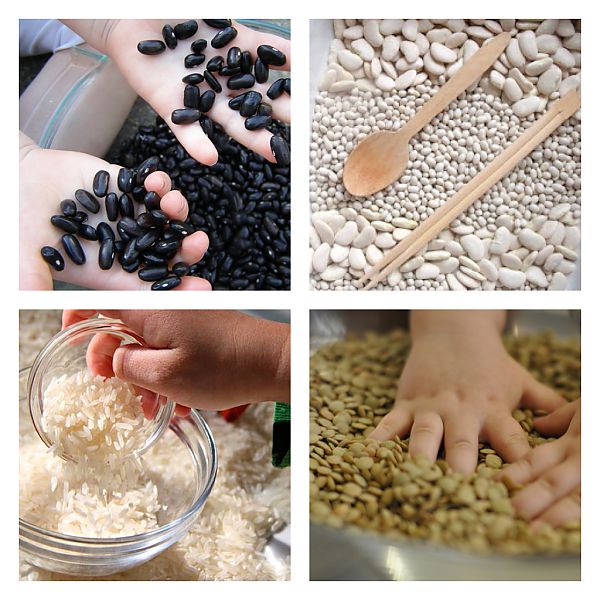
Mix the peas, beans and lentils (you can use beads of different colors) and ask the baby to sort them one by one into cups, the more “ingredients” the harder it is.
Play with clothespins, such as removing them from the edge of a bucket or cardboard. Older children will be able to "hook" them into place on their own.
Stick double-sided tape on a piece of cardboard and ask the crumb to lay out a track of buttons on it.
It is very interesting to stick small "peas" made of plasticine with your finger to paper. Thus, you can stick the apples to the tree. Prepare a cardboard hedgehog stencil, let the child first make him plasticine needles, and stick seeds on top.

Motor toys
The little ones will find rattles and cloth books interesting and useful. It is best if they are made of different materials, such as plastics combined with fabric or wood.
A mother who has sewing skills can sew a soft book herself. It is very simple to make it functional - place shreds of fabrics of different textures inside, come up with lacing, sew on the buttons tightly, do not forget about the "squeaks", "rustlers".
Offer a one-year-old baby a pyramid, sorters, constructors from large parts, logical ones - “colored columns” and “labyrinths”, pictures with inserts.

Large puzzles, mosaics, various lacing, especially on which beads can be strung, are suitable for children from 2 years old and older.


An irreplaceable thing will be a sensory box filled with cereals or pasta, or both. Place small toys, animal figurines, lids, corks, shells - whatever you can find there. Give your toddler toy dishes, a sandbox set, and other containers to place in cereals. Offer to take one piece with your fingers and put it in a glass. But the child must play strictly under your supervision.