Slings - getting to know each other

Modern mothers, even after the birth of their baby, want to stay informed and be able to be mobile at any time. To help them, special devices have been created, thanks to which you can comfortably accommodate a newborn baby or an older baby and go to an exhibition, a walk or on a trip. In this article we will understand what types of slings exist and how to use them correctly.
Contents
Ring sling
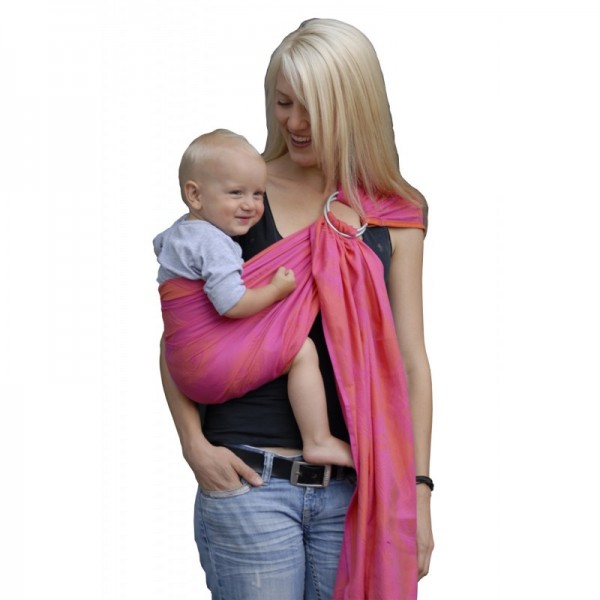
A ring sling is a two-meter scarf 60-70 cm wide, which is threaded through rings designed to adjust the length. This type of wearing device is most popular among parents. Unlike a sling-scarf, it is very convenient to use; you do not need to learn different types of windings, and the baby can be placed on his back, on his side or closer to the chest - due to this, you can feed him without removing him from the sling. 
Advantages of a ring sling over other carrying devices:
- If you learn how to use it correctly, you can find many poses for wearing it. baby from birth to three years.
- In a conveniently chosen position, the baby can sleep or stay awake for several hours in a row.
- Such devices can be made of lightweight material for summer and thicker fabric for winter. The scarf should be durable and made from natural, breathable materials.
- The rings are made of durable wood, metal or plastic, this allows you not to be afraid that the baby will accidentally fall out.

Sling jacket
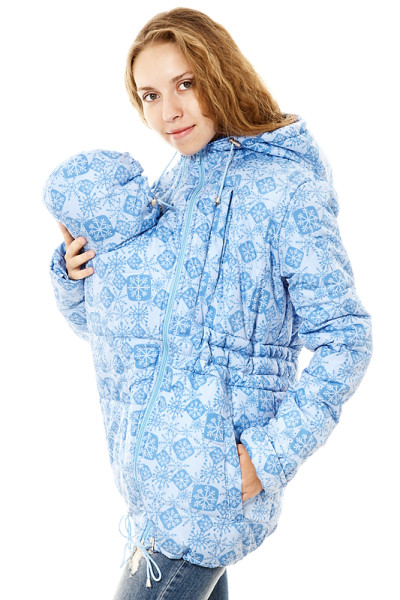
A babywearing jacket belongs to the category of outerwear, to which a separate element (sling insert) is attached; it has a special hole for the baby’s head. This way, the mother can put the baby in a baby carrier or sling scarf and go for a walk with him in the cold season. Such devices are intended for children who already know how to independently fix their head in a vertical position, usually this happens at 4-6 months. 
Why are parents around the world increasingly purchasing such a device for themselves?
- For mommies no need to worry about whether their child will freeze in an open stroller or in children's outerwear. The baby is always in a safe and warm place, because such jackets are made of dense materials.
- Parents are not tied to a stroller or sled; they are ready to go to the store, for a walk or to visit at any time.
- Modern babywearing jackets are equipped with spacious hoods for mother and child, as well as a special insert to support the baby's head.
- To give the child the opportunity to explore the world, the insert has separate slots for handles.
- Manufacturers offer a wide selection of babywearing jackets - they come in different colors and all kinds of styles.
 Sling backpack

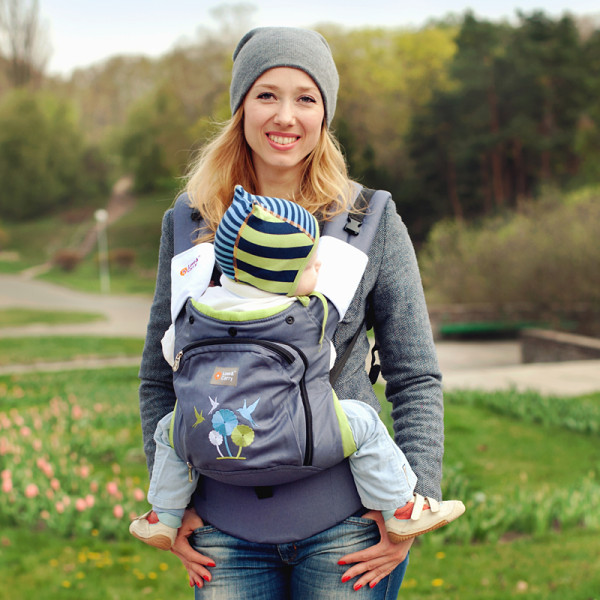
At the moment, there are two main types of baby carriers - “kunguru” and ergonomic backpack. Both can carry a baby from birth, if the devices are equipped with special inserts for newborns. But doctors recommend using these products no earlier than 5-6 months, when the baby can sit up independently and the vertical position will not harm his spine.
Previously, the most common method of transporting a child was a kangaroo. It has special straps and an insert that is securely attached to the mother's waist with clasps and belts. The resulting “pocket” is placed baby, having the ability to twist his head, exploring the world, and dangle his legs freely. However, many parents abandoned this product in favor of an ergo backpack, as orthopedists around the world recognized that the position of children in a “kangaroo” is unphysiological and can lead to the development of hip dysplasia. 
An ergo backpack is recognized as one of the safest means of carrying, because the child, sitting in it, takes the correct position - the knees are slightly higher than the butt, which sags a little, without creating pressure on the spinal column. In addition, the backpack, unlike a kangaroo, has a soft rather than hard back, thanks to which all parts of the child’s spine are securely fixed.

Sling scarf
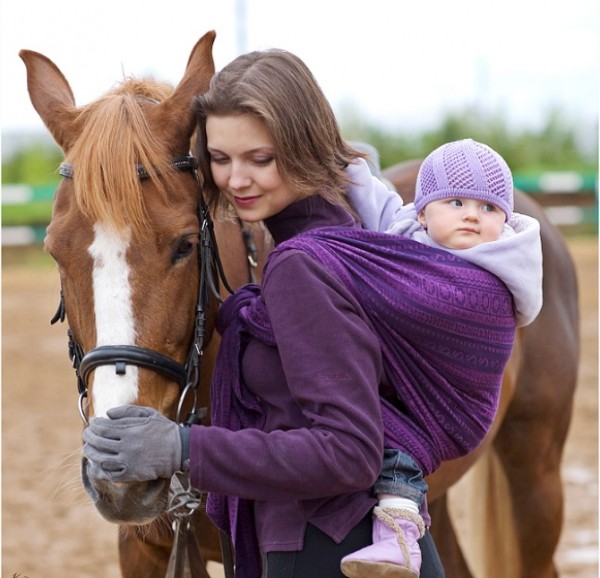
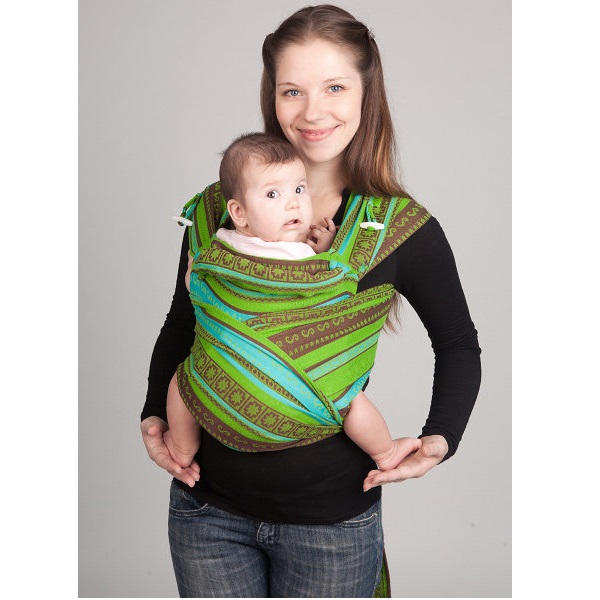
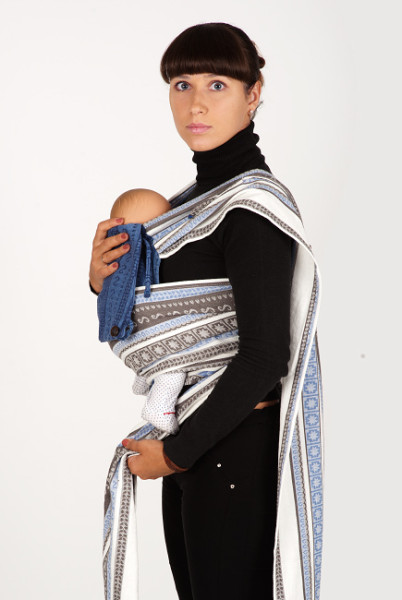
A sling scarf is one of the most practical and reliable ways to transport newborns. It is a woven piece of fabric about 80 cm wide and 4 to 6 meters long. There are several types of wearing - on the hip, on the back, on the stomach, in a horizontal and vertical position.
Experts say that this is the best type of carrying, since the baby is in the most natural position. At the same time, if you carry out the winding correctly, of which there are a huge number, the baby’s weight will be redistributed evenly onto the mother’s neck and shoulders, which is very important for long walks.
Pros of using a sling scarf:
- parents' hands are free;
- there is no heavy load on the mother’s back;
- you can breastfeed your baby without removing it from the device and without attracting the attention of strangers;
- some winding options have a head support function baby.
Main disadvantages:
- correct winding requires considerable experience;
- It’s not very convenient to use at home; you have to support the baby’s back;
- Beginner sling mothers will need a lot of time to prepare a scarf for wearing;
- due to the length of the scarf, it is not very practical to wrap it outside during the cold season;
- During the hot season, the baby may overheat due to the density of the fabric.

How to tie a sling
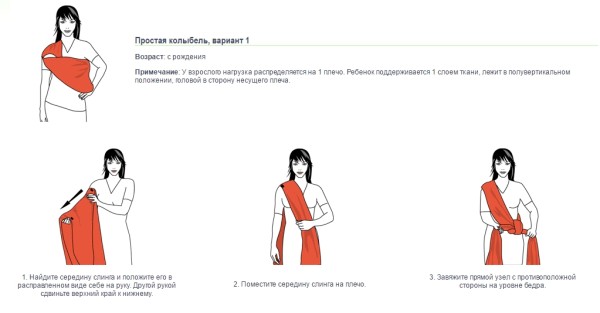
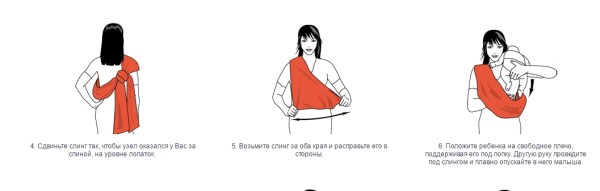
The easiest way to tie a baby sling is in the horizontal “cradle” position.
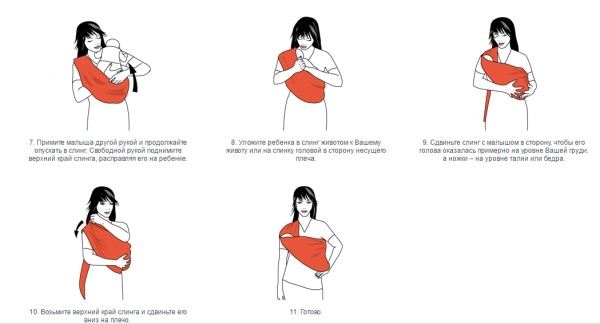 How to wear a sling


The ring sling has rightfully won the most devoted love of parents, because it allows you to carry the child in a position convenient for him, while completely freeing the mother’s hands.
Basic rules of use:
- The child needs to be pulled tightly towards you so that baby did not sag - the fragile spine of a newborn is not ready for such loads, because he does not yet support the back on his own. An incorrect position will also cause discomfort for the mother, creating unnecessary stress.
- All folds on the scarf, including on the strap and in the rings, must be carefully straightened, otherwise the fabric will rub the baby’s delicate skin, and due to improper weight distribution, the baby will appear heavier than he actually is.
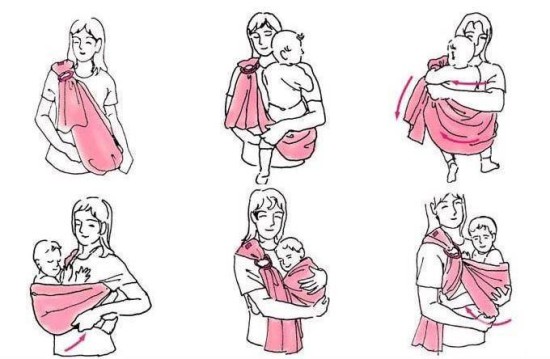
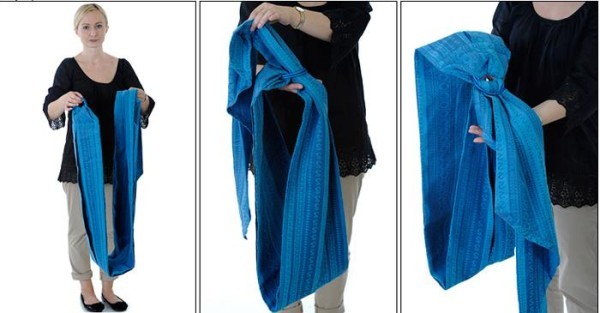
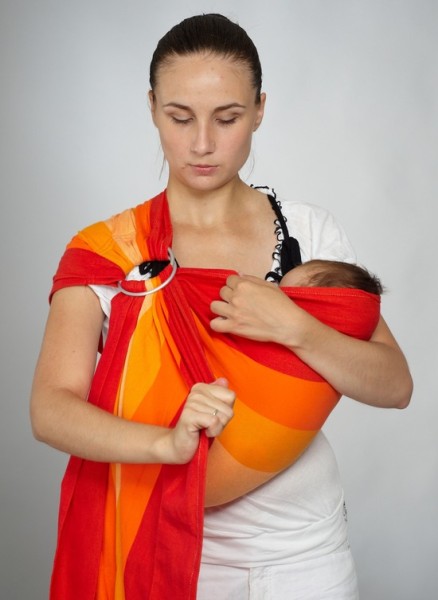
- If you buy a carrying device in a store, you receive it ready-made. But when sewing to order, you must independently prepare the sling for wearing. Fold the scarf in half and hold the ends in different hands. Thread the “tail” into both rings at once. Then wrap the top ring with fabric, and pull the bottom end into the bottom ring and straighten out all the folds. Before placing your baby in the sling, place it over your shoulder; while tightening, the rings should be at the collarbone or slightly below. Then place the baby in the “cradle” position - to do this, you need to eliminate all the unevenness, and then lay him on his side, with his head at the level of the mother’s chest, and his legs pointing towards the sides of the rings.
- The “front” position is also actively used, when the mother places the baby in the sling, slightly spreading his legs, and then tightens the scarf, fixing the baby, while the knees should be located slightly above the waist.
- Another popular way of carrying a slightly older baby is the “side” position. Its principle is similar to the previous one, only in this case the child is not in front, but slightly above the hip.
- From 6 months, baby
can be worn in the “back” position, where there are great opportunities for research and observation. how but


Which sling is better
0f88a9b351 

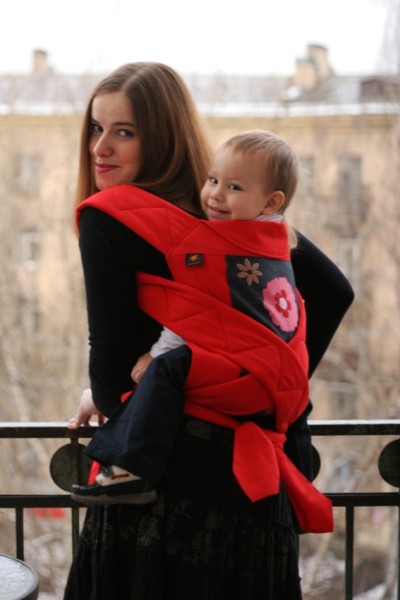
- These same carriers are ideal if you plan to transport your child outside, when going to the store or on walks. The weight in them is best distributed, so you will save your spine from unnecessary overloads. The May-sling also has a special insert; it will come in handy if the child falls asleep on the road.
- May-sling can be used from 3-4 months, when the baby begins to hold his head a little and can be carried in an upright position. The weight of a heavier child is evenly distributed on the neck, spine and lower back
- moms .
- By the time he reaches one year, the little explorer can already walk on his own, however, he is not able to cover long distances. In this case, a practical solution would be a sling with rings or an ergonomic backpack, in which you can quickly place the baby and can be worn on the hip or back. On long journeys, you can use a sling scarf; it will make carrying your child much easier.


Harm of a sling
Just ten years ago, a sling was a very exotic thing for us. Parents quickly realized how practical this device is compared to bulky strollers, because thanks to it they can move without any restrictions and even take their child on trips. In fact, such devices appeared long before the invention of the stroller. In the time of our great-great-grandmothers, children were worn with a scarf tied around them, which allowed them to work and run the household. 
Over time, slingomania literally took over the whole world and many mothers began to unite in communities, arguing their choice by the fact that the child is always close to his parents, feeling their love and care. A lot of research is being conducted on the harms and benefits of wearing a sling, but the debate between ardent fans and opponents regarding this issue does not subside to this day. Let's try to objectively understand the need to wear a sling.
- The most common argument against a sling is that it causes irreparable damage to the spine baby. In fact, most doctors are not against this method of carrying, but with some reservations:
- The design of the rings should be reliable and safe, and the fabric should be natural and high quality
- The sling should be used based on age restrictions.
- The main complaints about kangaroo carriers are that the weight in them is distributed incorrectly, and the baby seems to sag while sitting in it. This position can actually increase the risk of developing hip dysplasia and cause problems in the spine. In addition, sling bags are made of dense material with hard inserts; the child may overheat or suffer from lack of air.
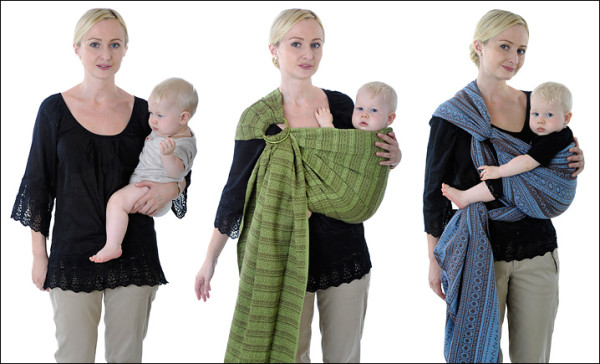

Another opinion of opponents of the sling is that the child is in a scarf in an uncomfortable position, for example, with legs spread wide apart or, conversely, with knees too tightly closed. But orthopedists agree that such positions are physiological and are even considered to prevent dysplasia. If the scarf is wound correctly and the baby is securely fixed, its back and hips are supported thanks to the dense fabric. 
Well, the last argument “against” is that a baby accustomed to constant and close contact with his mother will become capricious and restless during weaning from the sling. However, doctors and experienced mothers say the opposite. A child in the first years of life needs care and attention. In any case, the baby will demand to be carried in the arms, and a sling will become a practical alternative to this, so children cry much less, feeling confidence in their mother and her love. In addition, thanks to a better perception of the world around them, such children develop faster 
At what age can slings be used?
Beginning sling mothers often ask at what age can a child be placed in such a device. I must say that this question is not entirely correct; it’s not about the age of the baby, but about the experience of the parents. If the mother is able to position the baby correctly, according to its physiology, then you can carry the baby in a carrier from the first days of life.
- You can place your baby in a horizontal position immediately after birth. The baby is warm and comfortable there, like in a cradle. Some babies refuse to lie down after reaching 1-2 months, then you can leave the horizontal position only for feeding and rocking before bed. You can carry your baby this way until he likes it and is comfortable for you in any of the 4 types of slings. In a May-sling (a rectangular piece of fabric with straps sewn into the corners) and a pocket sling, this will be more difficult to do; this option is suitable for more experienced parents.
- The baby can be carried in an upright position in a frog or fetal position from the first days of life; it is worth starting with a few minutes of the child being in the sling, gradually increasing the time. However, most kids They settle in this way at about 3 months, when they learn to hold their head straight. The load on the spine is minimized, this is compensated by the tight attraction to the mother.
- Russian doctors recommend wearing a sling on the hip no earlier than 3 months. This option is similar to the front position, the child is positioned symmetrically, with legs apart. But holding the head in this case is very problematic. Therefore, it is worth using such a winding when the baby’s spine becomes stronger and he learns to easily fix his head.
- The supine position is the most difficult. It is allowed from the first days, however, sitting the baby in this way and breastfeeding is an almost impossible task. When your baby can independently hold his head and back in an upright position, feel free to purchase a sling or sling scarf.


Slings by age
There is no universal way to carry a baby, because what is good for a newborn is completely unsuitable for a more active older baby. Therefore, when choosing a babywearing product, experts suggest focusing on the age of the child. 
- From birth to three months, the baby's muscle corset has not yet formed, his spine is very fragile, any incorrect movement can disrupt it, so a carrying device that has a horizontal position is necessary. The head, back and neck must be fixed, take this into account if you plan to carry your baby for a long time. A sling with rings or a sling scarf are ideal for this occasion. From a sling with rings, the baby can easily be transferred to the cradle without waking him up if he suddenly falls asleep.
- From 4 months, the child can already roll over onto his stomach and hold his head up; it’s time to teach him to gradually sit up. To carry a baby vertically, it is better to purchase a sling scarf or a May-sling, the disadvantage of which is that it is impossible to transfer a sleeping child into a crib, since you will have to take him out of the backpack.
- Once your child reaches 8 months, you can use any carrier that has a vertical position function. Ergo backpacks are especially popular among parents. Their significant disadvantage is the presence of straps made of thick fabric - long-term wearing can lead to overheating of children.